
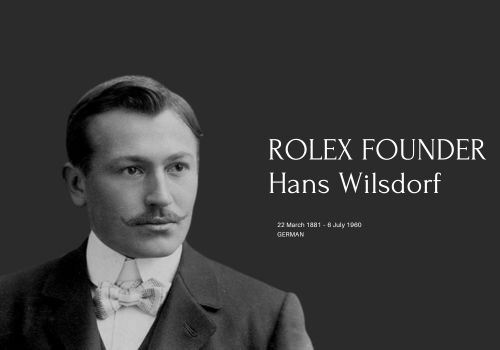
HANS WILSDORF: The Creative Mind of Rolex

Hans Wilsdorf is considered as one of the legends in watch history, he is the visionary founder of Rolex. As we begin the journey back in time, let’s unravel the remarkable story of a young gentleman  whose creativity and persistence in excellence changed for ever the world of watchmaking.
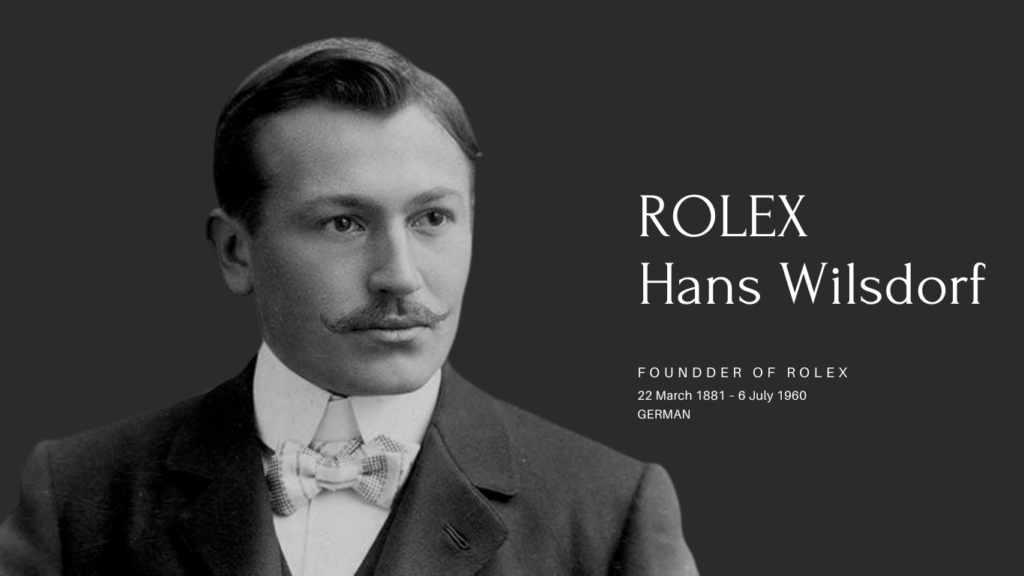
ROLEX Hans Wilsdorf
ROLEX Hans Wilsdorf

Early Life of HANS WILSDORF

Hans Wilsdorf’s amazing journey in this world began on the 22nd of March in 1881 in the streets of Kulmbach, Germany. A young man that kept a creative eye in the traditional world of watch manufacturing and transform it to a world of luxury, adventure and precision. In the early stage of his journey everyone could understand that this young men came to stay and his spirit could change for ever their world. 

But Why ROLEX?

This tricky question was answered by HANS WILSDORF and we quote:

 “I tried combining the letters of the alphabet in every possible way. This gave me some hundred names, but none of them felt quite right. One morning, while riding on the upper deck of a horse-drawn omnibus along Cheapside in the City of London, a genie whispered ‘Rolex’ in my ear.

The Birth of ROLEX

In 1905, the idea of Rolex was conceived and this was the beginning of this long journey that holds now over a century. Hans Wilsdorf passion for innovation led to the development of the first waterproof and dust proof watch, a groundbreaking achievement that solidified Rolex’s reputation for unparalleled craftsmanship.

HANS WILSDORF Precision  

Wilsdorf’s commitment to precision gave the ability to Rolex to stand out quickly. An important milestone was the introduction of the Oyster Perpetual in 1931, featuring a self-winding mechanism, that changed the watch history forever. This innovation not only enhanced accuracy but also was the birth of the automatic watches.

HANS WILSDORF Excellence

Under Wilsdorf’s guidance, Rolex became a status symbol that reflected the excellence in each field it was involved. Each Rolex timepiece was a statement and a sign of his commitment to quality, setting the brand among the top of the watch industry. In 1910, Rolex was the first watch manufacturing company that received the Swiss Certificate of Chronometric Precision,  by the Official Watch Rating Centre in Vienne.

Legacy of Mr Rolex

Hans Wilsdorf’s legacy lives on in every Rolex watch till now. His creativity and perfectionism left an indelible mark on the world of horology and change it for ever. Without HANS WILSDORF the watch industry would not be the same. 

Want to learn more about Rolex History? Check out our article that describes how everything started

Feel free to contact and share your thoughts with us your feedback is important as we are trying to create a unique interactive community for all the watch fanatics. 

Author

  • Julien Favre

    Vallée de Joux, Switzerland — Contributing Editor, high complications & independent watchmaking
    Julien Favre learned the difference between good silence and bad silence before he was ten. Good silence was his grandfather at the bench in Le Sentier, loupe screwed into one eye, breathing shallow over a disassembled minute repeater. Bad silence was the moment a hairspring pinged off the peg-wood and disappeared into the floorboards. The family atelier — three generations of movement servicing for the maisons that carpet the Vallée de Joux — was never framed as a legacy Julien was expected to join. It simply was the house, the way weather is the house in a mountain valley.
    He resisted it, predictably. He studied economics in Lausanne and spent two years in Geneva watch retail, selling the objects rather than opening them. What pulled him back was not sentiment but frustration: he found he could describe why a movement was beautiful far better than anyone selling it could, because he had seen its underside. He started writing — first a blog dissecting finishing under macro photography, then commissioned work for the trade press, then features that treated escapements the way music critics treat a fugue.
    Julien now covers high complications, restoration, and the fragile economics of independent watchmaking for European and English-language titles. His reporting is unusually technical without being cold; he is as interested in the person hunched over the bench as in the tolerances they hold. He is skeptical of hype, allergic to press-release adjectives, and reliably the first to notice when a "revolutionary" caliber is a reworked ébauche.
    He still returns to the family workshop each winter to service a single pocket watch on his grandfather's bench — a discipline, he says, that keeps his writing honest. A critic who cannot do the thing risks worshipping it.
    Byline version: Julien Favre is a contributing editor covering high complications and independent watchmaking. He grew up in a movement-servicing atelier in the Vallée de Joux and still works the family bench each winter

    Author
Author

Vallée de Joux, Switzerland — Contributing Editor, high complications & independent watchmaking Julien Favre learned the difference between good silence and bad silence before he was ten. Good silence was his grandfather at the bench in Le Sentier, loupe screwed into one eye, breathing shallow over a disassembled minute repeater. Bad silence was the moment a hairspring pinged off the peg-wood and disappeared into the floorboards. The family atelier — three generations of movement servicing for the maisons that carpet the Vallée de Joux — was never framed as a legacy Julien was expected to join. It simply was the house, the way weather is the house in a mountain valley. He resisted it, predictably. He studied economics in Lausanne and spent two years in Geneva watch retail, selling the objects rather than opening them. What pulled him back was not sentiment but frustration: he found he could describe why a movement was beautiful far better than anyone selling it could, because he had seen its underside. He started writing — first a blog dissecting finishing under macro photography, then commissioned work for the trade press, then features that treated escapements the way music critics treat a fugue. Julien now covers high complications, restoration, and the fragile economics of independent watchmaking for European and English-language titles. His reporting is unusually technical without being cold; he is as interested in the person hunched over the bench as in the tolerances they hold. He is skeptical of hype, allergic to press-release adjectives, and reliably the first to notice when a "revolutionary" caliber is a reworked ébauche. He still returns to the family workshop each winter to service a single pocket watch on his grandfather's bench — a discipline, he says, that keeps his writing honest. A critic who cannot do the thing risks worshipping it. Byline version: Julien Favre is a contributing editor covering high complications and independent watchmaking. He grew up in a movement-servicing atelier in the Vallée de Joux and still works the family bench each winter

Comments are closed.