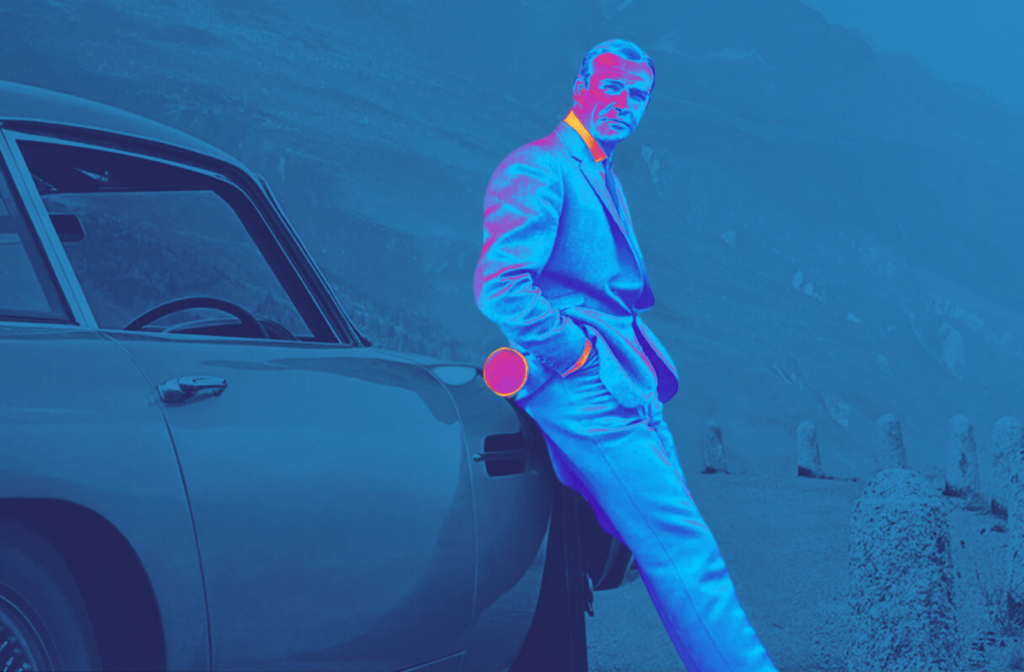
The Rolex “Bond Submariner” watch 6538 is the original Submariner to be featured in James Bond/007 films. Both Connery and Roger Moore sported a number of different Sub references during their respective tenures, but it’s the first model 007 wore as he set about ruining Dr. No’s plans for world domination that will be forever be known as the Bond Submariner, a vintage Rolex Submariner that is incredibly hard to find.
The Iconic Rolex Submariner 6538: A Legacy of Bond Films and Collector Prestige
The 6538 gained a lot of attention among Rolex fanatics. With its unique black, rotating bezel, an amazing added feature since the watch’s inception, it was influenced by Rolex’s own Turn-O-Graph ref. 6202. The ref. 6538 was produced with a massive variation of different dials with tiny changes concerning the color or the amount of text, assuming that these changes that we can notice were randomly produced.
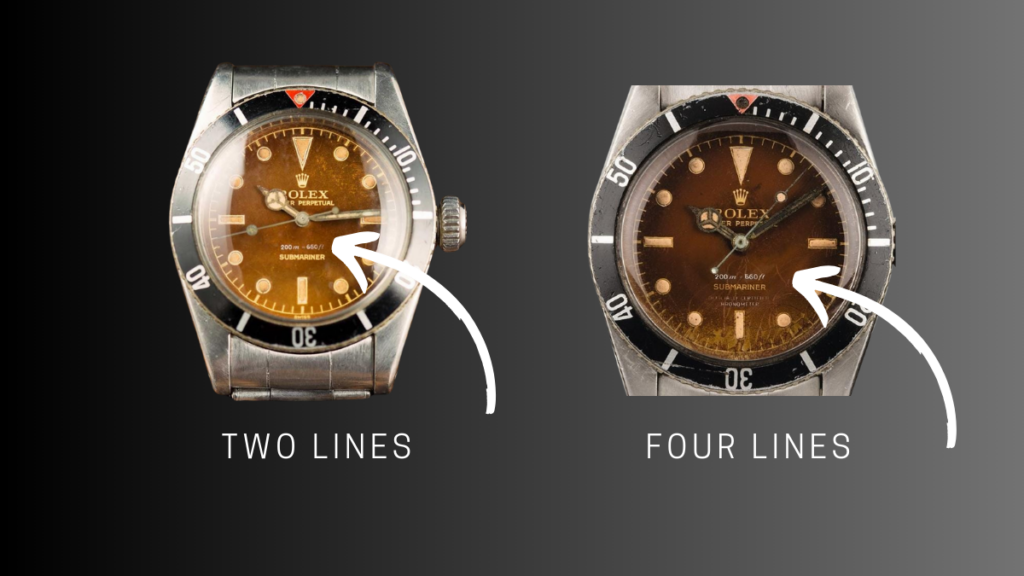
Among the most immediately noticeable differences between certain types of watches is whether they have what is known as 2-line or 4-line dials.
Produced between 1954 and 1959, the 38 mm tonneau thinner-shaped Oyster case features more beveled lugs, a screw back, and a large screw-down crown. It is waterproof under water pressure up to an impressive 300 meters or 1000 feet. The Rolex Submariner 6538, with its caliber 1030 nickel-finished lever and 25-jewel movement, became the first of the brand’s calibers to gain official chronometer status, winning certification after challenging testing from the COSC. While all Submariner 6538 watches are highly popular among watch collectors, one is getting more attention than the others and is highly collectable and hard to get due to its limited production and 4-line dial.
Want to learn more about Rolex History? Check out our article that describes how everything started.
Feel free to contact and share your thoughts with us your feedback is important as we are trying to create a unique interactive community for all the watch fanatics.
Vallée de Joux, Switzerland — Contributing Editor, high complications & independent watchmaking
Julien Favre learned the difference between good silence and bad silence before he was ten. Good silence was his grandfather at the bench in Le Sentier, loupe screwed into one eye, breathing shallow over a disassembled minute repeater. Bad silence was the moment a hairspring pinged off the peg-wood and disappeared into the floorboards. The family atelier — three generations of movement servicing for the maisons that carpet the Vallée de Joux — was never framed as a legacy Julien was expected to join. It simply was the house, the way weather is the house in a mountain valley.
He resisted it, predictably. He studied economics in Lausanne and spent two years in Geneva watch retail, selling the objects rather than opening them. What pulled him back was not sentiment but frustration: he found he could describe why a movement was beautiful far better than anyone selling it could, because he had seen its underside. He started writing — first a blog dissecting finishing under macro photography, then commissioned work for the trade press, then features that treated escapements the way music critics treat a fugue.
Julien now covers high complications, restoration, and the fragile economics of independent watchmaking for European and English-language titles. His reporting is unusually technical without being cold; he is as interested in the person hunched over the bench as in the tolerances they hold. He is skeptical of hype, allergic to press-release adjectives, and reliably the first to notice when a "revolutionary" caliber is a reworked ébauche.
He still returns to the family workshop each winter to service a single pocket watch on his grandfather's bench — a discipline, he says, that keeps his writing honest. A critic who cannot do the thing risks worshipping it. Byline version: Julien Favre is a contributing editor covering high complications and independent watchmaking. He grew up in a movement-servicing atelier in the Vallée de Joux and still works the family bench each winter
Vallée de Joux, Switzerland — Contributing Editor, high complications & independent watchmaking
Julien Favre learned the difference between good silence and bad silence before he was ten. Good silence was his grandfather at the bench in Le Sentier, loupe screwed into one eye, breathing shallow over a disassembled minute repeater. Bad silence was the moment a hairspring pinged off the peg-wood and disappeared into the floorboards. The family atelier — three generations of movement servicing for the maisons that carpet the Vallée de Joux — was never framed as a legacy Julien was expected to join. It simply was the house, the way weather is the house in a mountain valley.
He resisted it, predictably. He studied economics in Lausanne and spent two years in Geneva watch retail, selling the objects rather than opening them. What pulled him back was not sentiment but frustration: he found he could describe why a movement was beautiful far better than anyone selling it could, because he had seen its underside. He started writing — first a blog dissecting finishing under macro photography, then commissioned work for the trade press, then features that treated escapements the way music critics treat a fugue.
Julien now covers high complications, restoration, and the fragile economics of independent watchmaking for European and English-language titles. His reporting is unusually technical without being cold; he is as interested in the person hunched over the bench as in the tolerances they hold. He is skeptical of hype, allergic to press-release adjectives, and reliably the first to notice when a "revolutionary" caliber is a reworked ébauche.
He still returns to the family workshop each winter to service a single pocket watch on his grandfather's bench — a discipline, he says, that keeps his writing honest. A critic who cannot do the thing risks worshipping it.
Byline version: Julien Favre is a contributing editor covering high complications and independent watchmaking. He grew up in a movement-servicing atelier in the Vallée de Joux and still works the family bench each winter







Comments are closed.