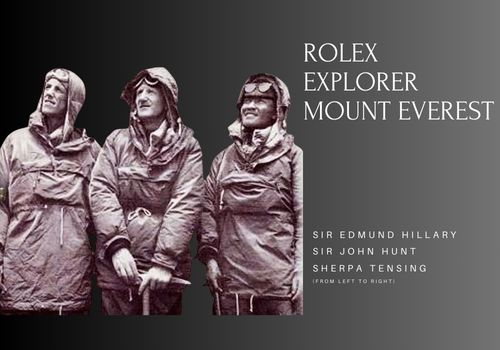
ROLEX EXPLORER History

Rolex Explorer the watch that every explorer should have, keeping deep in its DNA the danger, the reveals, the conger, the feelings, the joy, the worry, the excitement of many explorers. For me is considered as the watch that keeps inside many feelings and actually keeps inside the meaning of life, to continue our journey when everything is not going according to our plans and to explore new ideas, culture, feeling , smells and actually to explore life in all its senses.

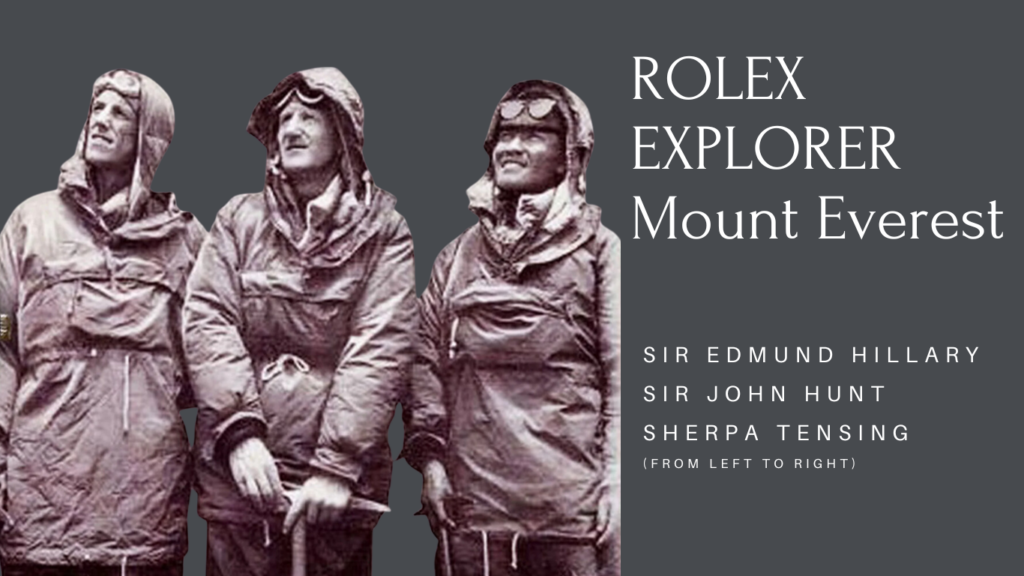
In 1953 Rolex launched a new watch addressed to the special needs of the explorers and the adventurous, the new Explorer. Making its first public debut at Mount Everest and forever linked with the great expedition that was led by Sir John Hunt. 
ROLEX EXPLORER
ROLEX EXPLORER MOUNT EVEREST

1952, Explorer Ref 6098 and 6150

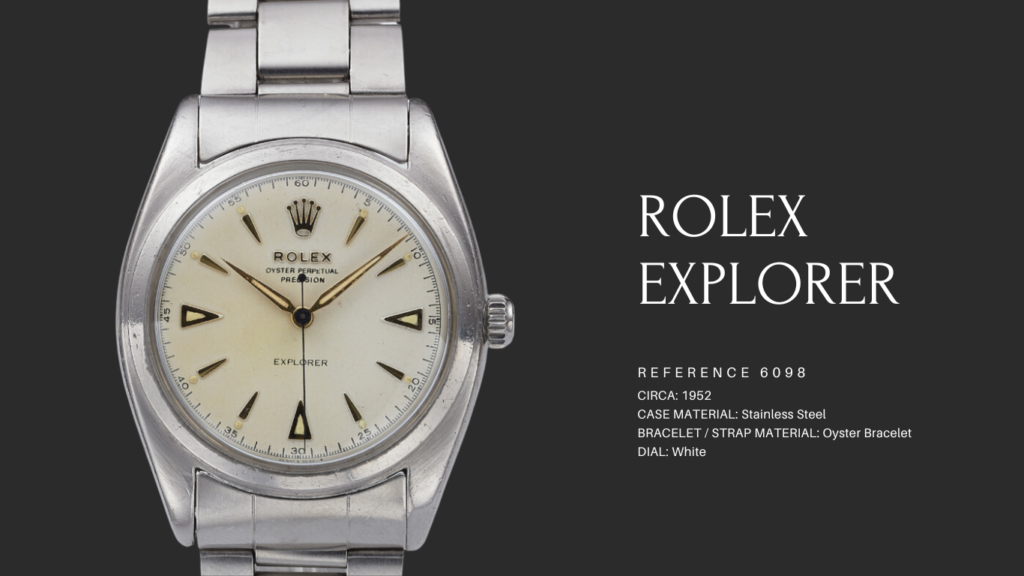
In the beginning of 1950s Rolex was famous for the extremely reliable, waterproof, under any condition tough and accurate watches. In order to move a step further towards that direction Rolex is focusing on creating a new series of watches exclusively designed to the extreme sometimes needs and conditions of the explorers. Starting its first efforts and designs in 1950 two years later in 1952 it is ready to give its new watch, the Explorer with reference 6098 and 6150, to a selected group of people that they are going to test it under extreme conditions.

At this stage it is noticeable that the watch doesn’t have a name on the dial singing this series and was accompanied with the characteristic Bubble Back case, accompanied with a white dial and the characteristic triangle made from steel or bras pointing 3,6 and nine o clock. The first models of Explorer 6298 and 6150 were characterized as Precision and it was until 6350 that we could spot Explorer at the dial. 
ROLEX EXPLORER 6098
ROLEX EXPLORER 6098


Late 1950’s ROLEX EXPLORER Expansion

In the late 1950’s Rolex enjoyed a fast growth in the new markets of Asia and North America. In order to continue Explorer success it created a new model that used the successful characteristic dial of the Explorer but now with a 19 mm bracelet and a 1520 movement that was named Air-King. Also in this period Rolex stopped producing Honeycomp dial, textured dial, for the Explorer.

ROLEX EXPLORER EXPANSION

1960’s ROLEX EXPLORER

In the early 1960s Rolex is changing the mark on the bottom of the dial from Swiss to Swiss T<25  
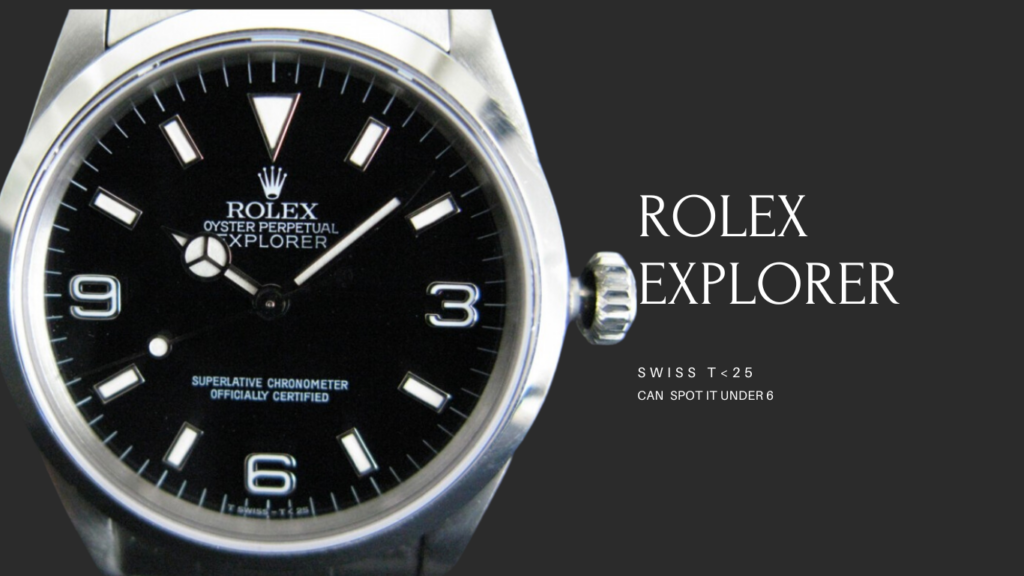
ROLEX EXPLORER T 25
ROLEX EXPLORER T 25

1970‘s ROLEX EXPLORER 1655 FRECCIONE

In the early 1970s Rolex made a lot of changes for Rolex Explore, the Rolex crown logo changed. The first model to be spotted with this significant change was Rolex Explorer under the Reference 1016. At the same period  we notice that on models with reference 5500 on the bottom of the dial they are adding Precision. A fresh start for Explorer begun with the introduction of the Explorer II that was launched in 1971 under the reference 1655. 1655 is also known as Freccione coming from the Italian word that means the arrow due to its large and brightly colored hands as seen in the photo below.
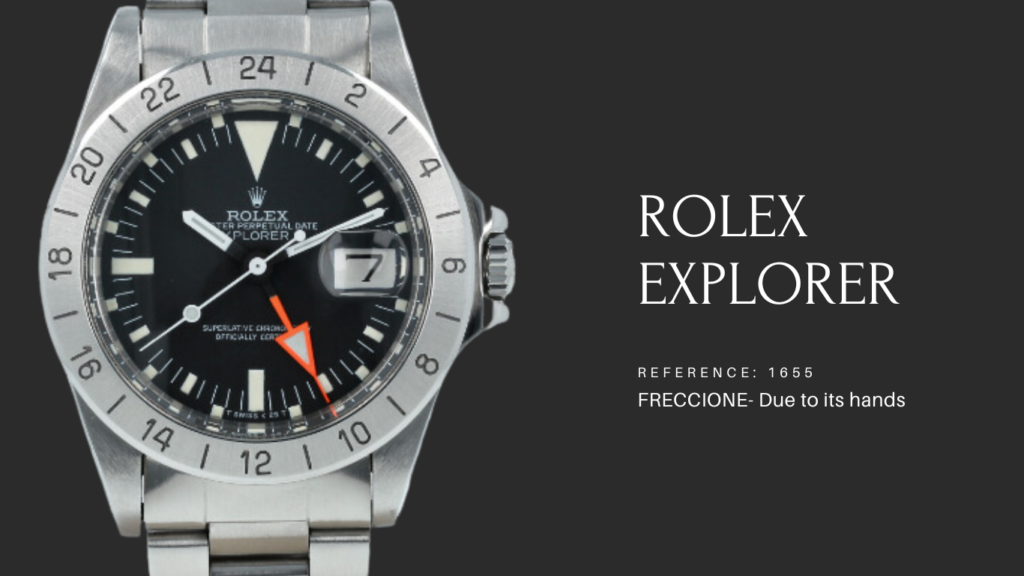
ROLEX EXPLORER 1655 FRECCIONE


Want to learn more about Rolex Explorer Models?


Author

  • Julien Favre

    Vallée de Joux, Switzerland — Contributing Editor, high complications & independent watchmaking
    Julien Favre learned the difference between good silence and bad silence before he was ten. Good silence was his grandfather at the bench in Le Sentier, loupe screwed into one eye, breathing shallow over a disassembled minute repeater. Bad silence was the moment a hairspring pinged off the peg-wood and disappeared into the floorboards. The family atelier — three generations of movement servicing for the maisons that carpet the Vallée de Joux — was never framed as a legacy Julien was expected to join. It simply was the house, the way weather is the house in a mountain valley.
    He resisted it, predictably. He studied economics in Lausanne and spent two years in Geneva watch retail, selling the objects rather than opening them. What pulled him back was not sentiment but frustration: he found he could describe why a movement was beautiful far better than anyone selling it could, because he had seen its underside. He started writing — first a blog dissecting finishing under macro photography, then commissioned work for the trade press, then features that treated escapements the way music critics treat a fugue.
    Julien now covers high complications, restoration, and the fragile economics of independent watchmaking for European and English-language titles. His reporting is unusually technical without being cold; he is as interested in the person hunched over the bench as in the tolerances they hold. He is skeptical of hype, allergic to press-release adjectives, and reliably the first to notice when a "revolutionary" caliber is a reworked ébauche.
    He still returns to the family workshop each winter to service a single pocket watch on his grandfather's bench — a discipline, he says, that keeps his writing honest. A critic who cannot do the thing risks worshipping it.
    Byline version: Julien Favre is a contributing editor covering high complications and independent watchmaking. He grew up in a movement-servicing atelier in the Vallée de Joux and still works the family bench each winter

    Author
Author

Vallée de Joux, Switzerland — Contributing Editor, high complications & independent watchmaking Julien Favre learned the difference between good silence and bad silence before he was ten. Good silence was his grandfather at the bench in Le Sentier, loupe screwed into one eye, breathing shallow over a disassembled minute repeater. Bad silence was the moment a hairspring pinged off the peg-wood and disappeared into the floorboards. The family atelier — three generations of movement servicing for the maisons that carpet the Vallée de Joux — was never framed as a legacy Julien was expected to join. It simply was the house, the way weather is the house in a mountain valley. He resisted it, predictably. He studied economics in Lausanne and spent two years in Geneva watch retail, selling the objects rather than opening them. What pulled him back was not sentiment but frustration: he found he could describe why a movement was beautiful far better than anyone selling it could, because he had seen its underside. He started writing — first a blog dissecting finishing under macro photography, then commissioned work for the trade press, then features that treated escapements the way music critics treat a fugue. Julien now covers high complications, restoration, and the fragile economics of independent watchmaking for European and English-language titles. His reporting is unusually technical without being cold; he is as interested in the person hunched over the bench as in the tolerances they hold. He is skeptical of hype, allergic to press-release adjectives, and reliably the first to notice when a "revolutionary" caliber is a reworked ébauche. He still returns to the family workshop each winter to service a single pocket watch on his grandfather's bench — a discipline, he says, that keeps his writing honest. A critic who cannot do the thing risks worshipping it. Byline version: Julien Favre is a contributing editor covering high complications and independent watchmaking. He grew up in a movement-servicing atelier in the Vallée de Joux and still works the family bench each winter

Comments are closed.