Today we are going to talk about one of the most not so well known model of Rolex, ROLEX CELLINI. The first time that it was introduced to me I didn’t recognise any of the characteristic elements of Rolex aesthetic. It was a pretty gold Cellini that belonged to one of my fathers clients, a quite rare, beautiful manual winding in a perfect condition vintage wrist watch that made me be curious and search a little bit more regarding its history and frankly was really surprised from my findings.
Did not took my breath away but totally catched my eye as it was unique and beautiful in a totally different way. It was this kind of love that starts quiet but after a few days you cant take your mind out of it.
ROLEX CELLINI History
Cellini was first introduced to the market in 1968 as a dress watch, a watch that you can wear in formal gatherings and it was named after the Buenvenuto Cellini, an Italian painter and goldsmith that lived between 1500-1571 in Florence and is well known for his sculpture of Perseus with the Head of Medusa from the Greek Mythology.
Since 1968 many models have introduced in the international markets, all of them unique holding the tradition of manual winding watches quite rare if you considered the rest sporty looks of Rolex watches and so exclusive and luxury with a variety of gold, platinum and diamond watches. Although not really famous considered other models in that category such as SARU, LEOPARD etc they are playing an important watch among elegant, exclusive and luxury watches and have their own small but yet important audience.
ROLEX CELLINI Models and Reference Numbers
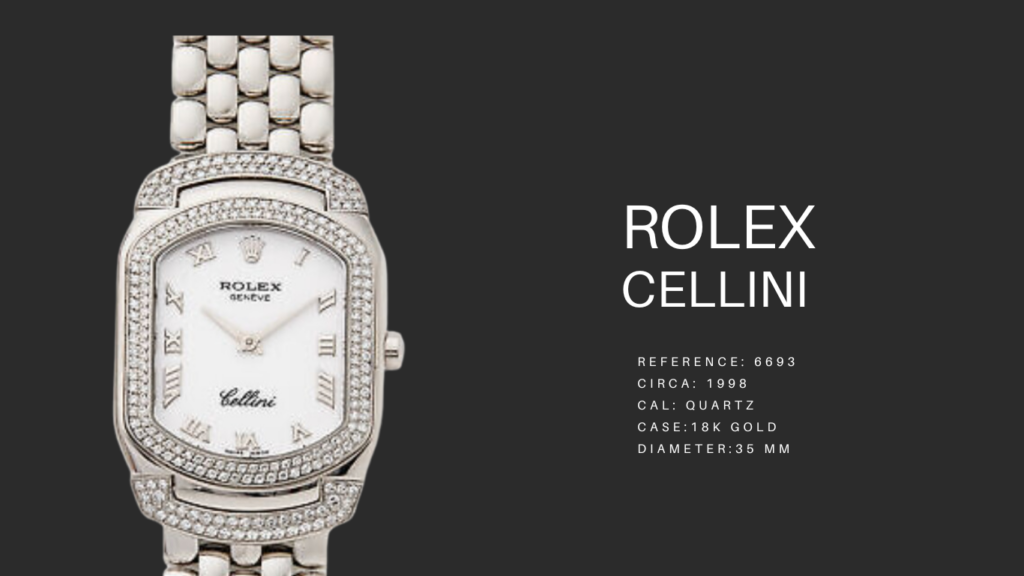
ROLEX CELLINI Ref 6693
ROLEX CELLINI Ref 6693
Technical Characteristics
REFERENCE: 6693
CIRCA: 1998
CAL: quartz
CASE:18k gold
DIAMETER:35 mm
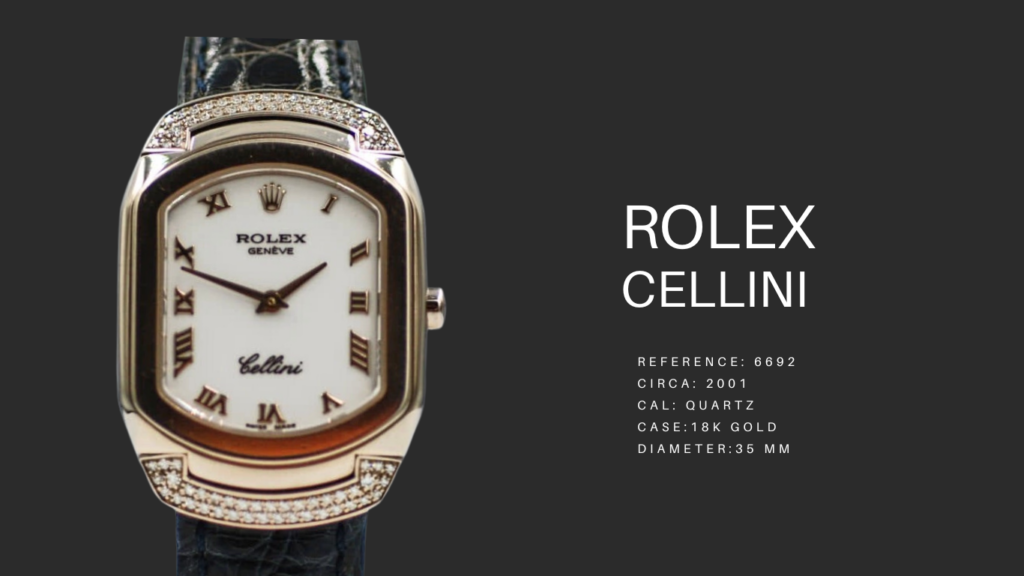
ROLEX CELLINI Ref 6692
ROLEX CELLINI 6692
Technical Characteristics
REFERENCE: 6692
CIRCA: 2001
CAL: quartz
CASE:18k gold
DIAMETER:35 mm
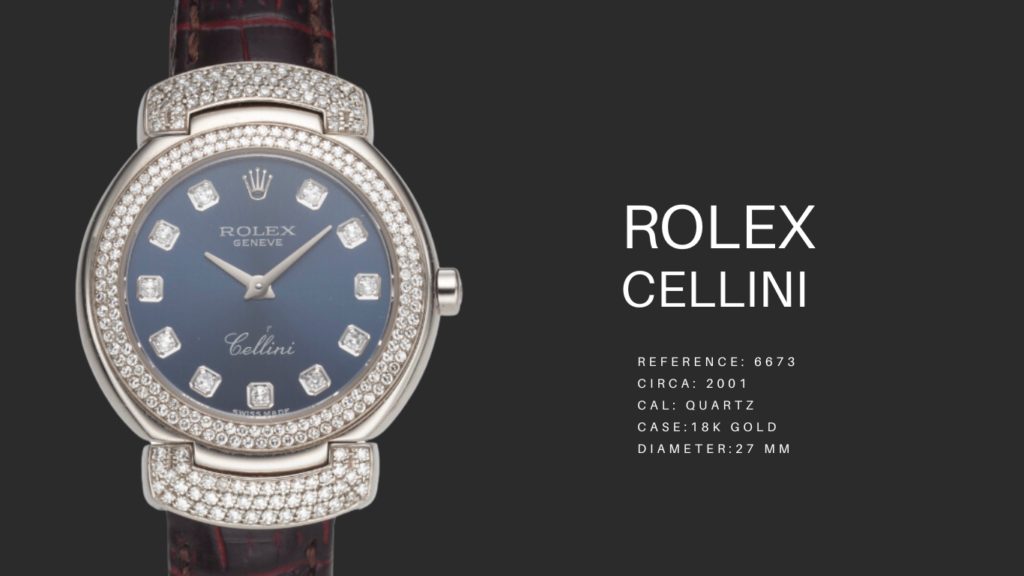
ROLEX CELLINI Ref 6673
ROLEX CELLINI 6673
Technical Characteristics
REFERENCE: 6673
CIRCA: 2001
CAL: quartz
CASE:18k gold
DIAMETER:27 mm
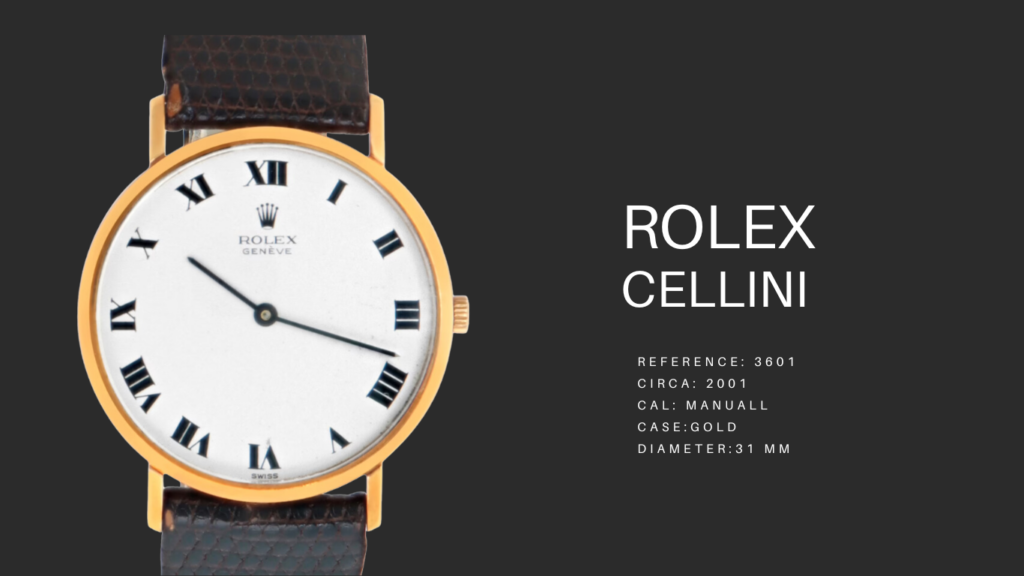
ROLEX CELLINI Ref 3601
ROLEX CELLINI 3601
Technical Characteristics
REFERENCE: 3601
CIRCA: 2001
CAL: MANUALL
CASE:GOLD
DIAMETER:31 mm
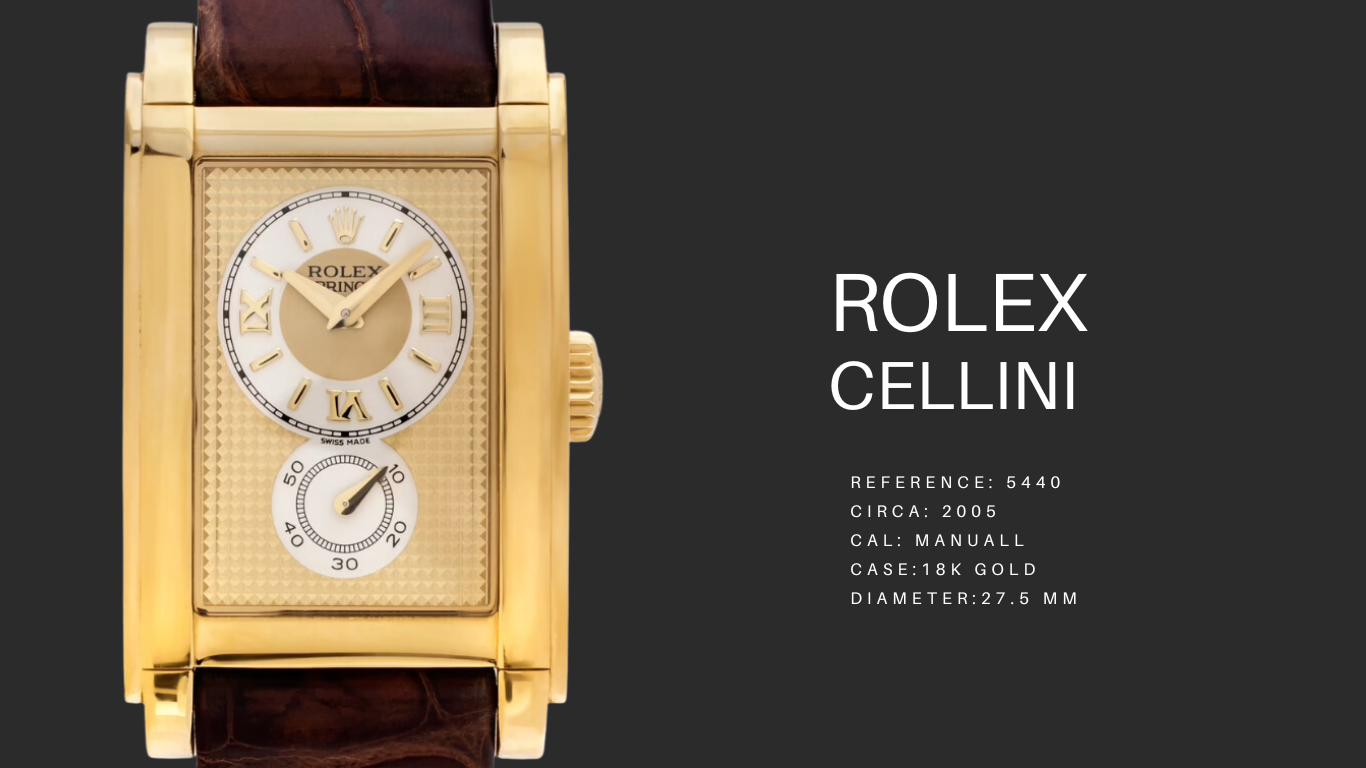
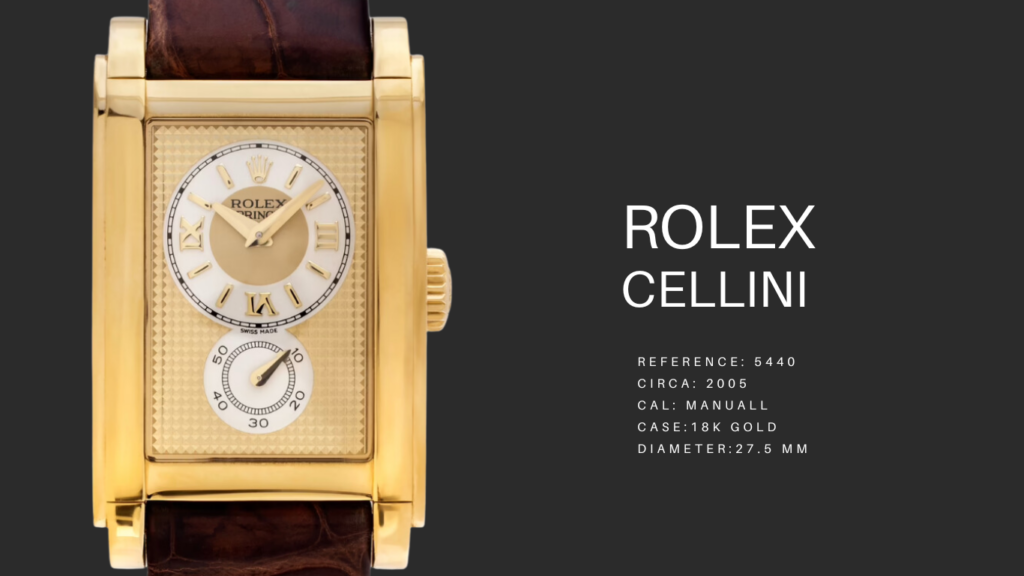
ROLEX CELLINI Ref 5540
ROLEX CELLINI 5440
Technical Characteristics
REFERENCE: 5440
CIRCA: 2005
CAL: MANUALL
CASE:18K GOLD
DIAMETER:27.5 mm
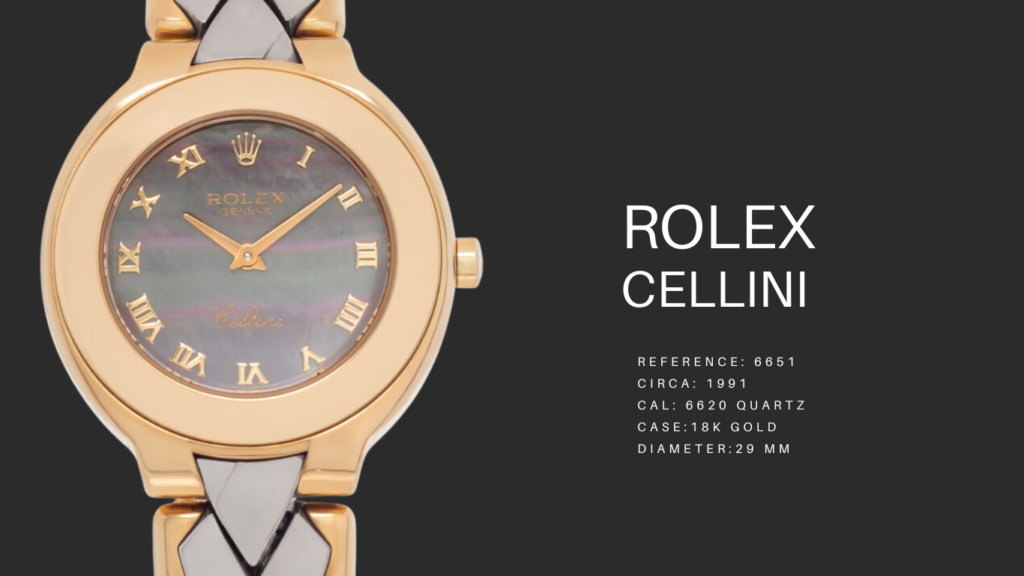
ROLEX CELLINI Ref 6651
ROLEX CELLINI 6651
Technical Characteristics
REFERENCE: 6651
CIRCA: 1991
CAL: 6620 quartz
CASE:18k gold
DIAMETER:29 mm
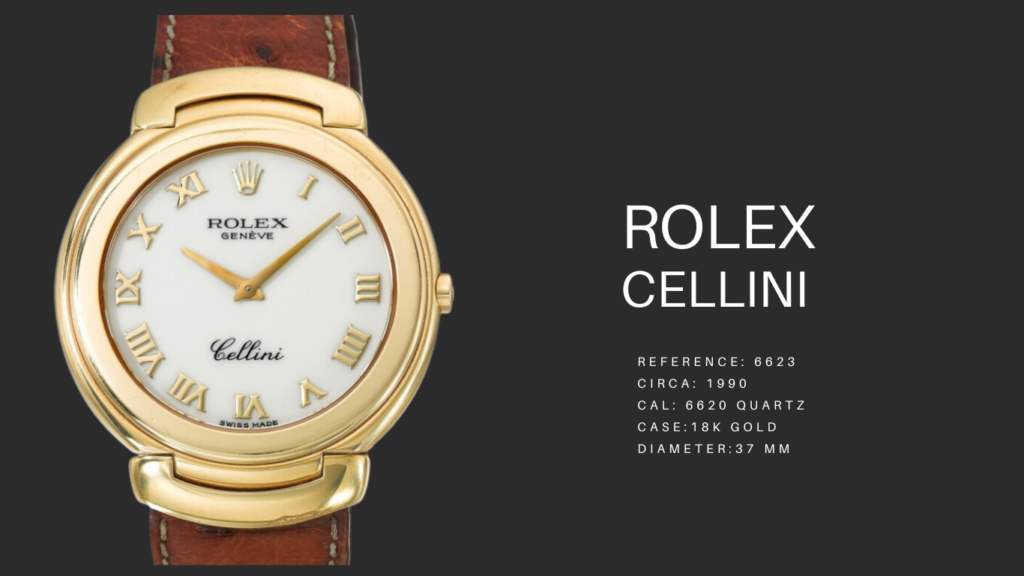
ROLEX CELLINI Ref 6623
ROLEX CELLINI 6623
Technical Characteristics
REFERENCE: 6623
CIRCA: 1990
CAL: 6620 quartz
CASE:18k gold
DIAMETER:37 mm
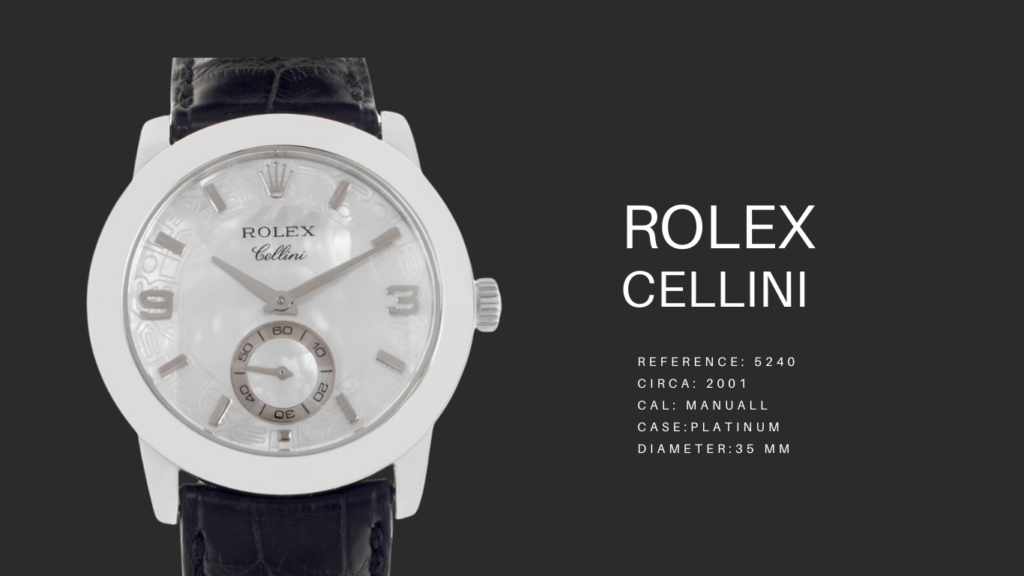
ROLEX CELLINI Ref 5240
ROLEX CELLINI 5240
Technical Characteristics
REFERENCE: 5240
CIRCA: 2001
CAL: MANUALL
CASE:PLATINUM
DIAMETER:35 mm
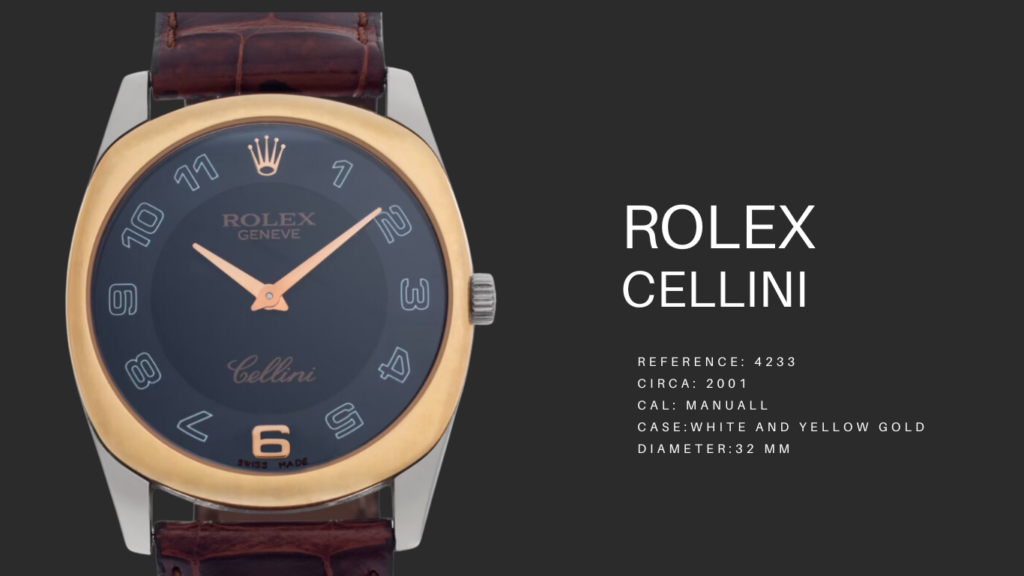
ROLEX CELLINI Ref 4233
ROLEX CELLINI 4233
Technical Characteristics
REFERENCE: 4233
CIRCA: 2001
CAL: MANUALL
CASE:WHITE AND YELLOW GOLD
DIAMETER:32 mm
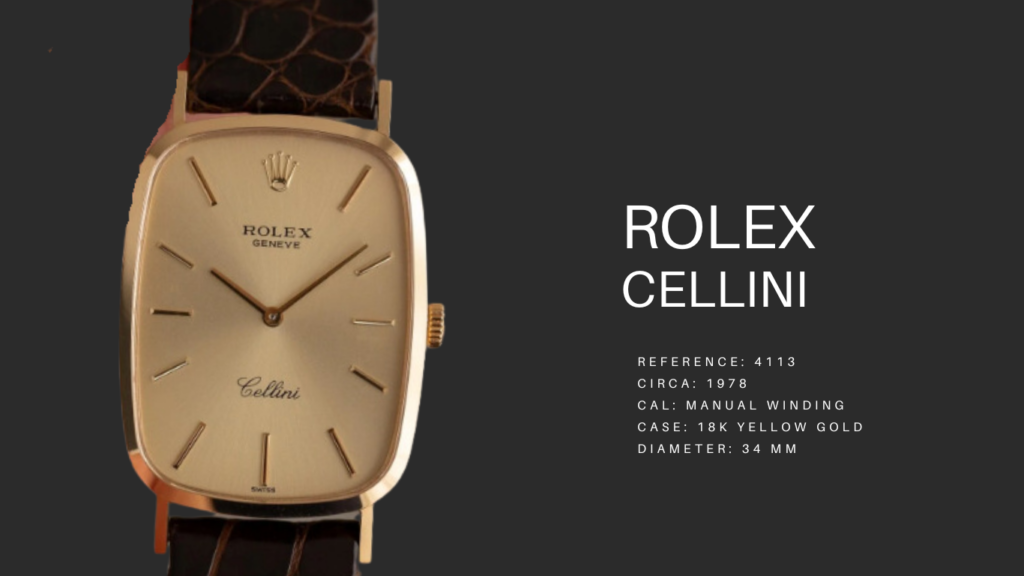
ROLEX CELLINI Ref 4113
ROLEX CELLINI Ref 4113
Technical Characteristics
REFERENCE: 4113
CIRCA: 1978
CAL: manual winding
CASE: 18k yellow gold
DIAMETER: 34 mm
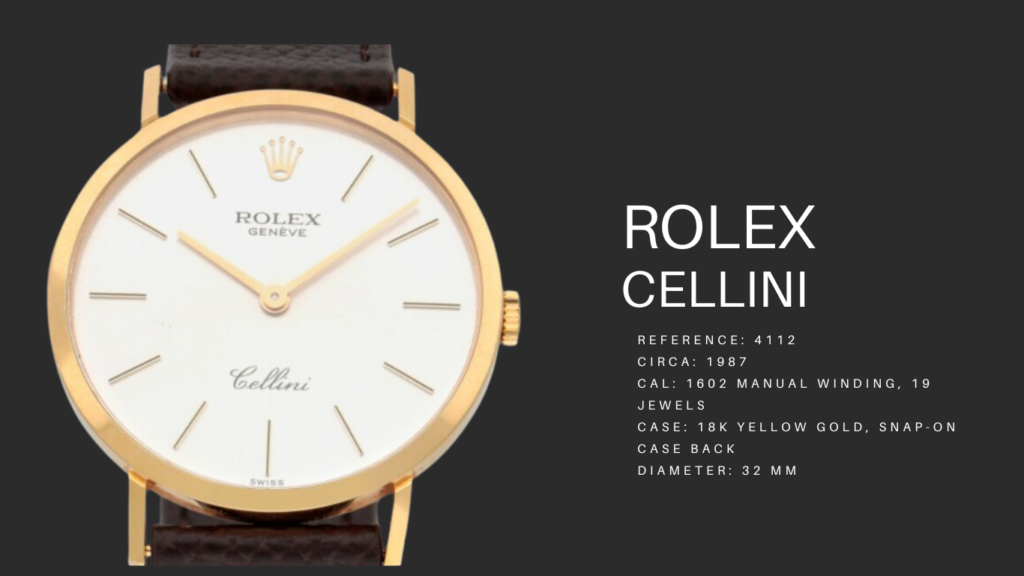
ROLEX CELLINI Ref 4112
ROLEX CELLINI 4112
Technical Characteristics
REFERENCE: 4112
CIRCA: 1987
CAL: 1602 manual winding, 19 jewels
CASE: 18k yellow gold, snap-on case back
DIAMETER: 32 mm
Want to learn more about ROLEX HISTORY? Thank you for reading our articles as this we considered to be an ongoing process feel free to send us your thoughts. Drop a line anytime we would be more than happy to get your feedback.
Florence, Italy — Contributing Editor, design & aesthetics
Chiara Nardi grew up above a workshop that smelled of pickling acid and polishing rouge. The Nardi family have been goldsmiths in Florence for four generations, close enough to the Ponte Vecchio to hear the tourists; Chiara set stones and drew her first cases before she was allowed to use the rolling mill unsupervised. Watches entered her life as a subset of jewelry — objects judged first by proportion, weight in the hand, and the relationship between a dial and the wrist it lived on.
She trained formally in design in Milan and briefly designed cases for a component supplier, which taught her how compromised the beautiful object usually is by the time it reaches a boutique. She turned to writing because she wanted to argue about aesthetics in public rather than lose those arguments privately in a meeting.
Chiara covers watch design and the applied arts of the dial — enameling, guilloché, stone-setting, the near-lost decorative crafts the industry alternately celebrates and underpays. She writes with a maker's eye and a maker's impatience: she can tell when a "hand-finished" bevel was finished by a machine, and she names it. She is also one of the sharper voices on the industry's awkward relationship with women — as customers, as designers, and as the vast unnamed workforce that does the delicate assembly while men front the campaigns.
Her prose is sensory and precise. She writes about the tactility of objects the way food critics write about texture, and she refuses the lazy shorthand of "feminine" and "masculine" watches, which she considers marketing rather than design.
She still returns to the family bench to set stones by hand — proof, she says, that her opinions are earned. Byline version: Chiara Nardi is a contributing editor covering watch design and dial craft. A fourth-generation Florentine goldsmith, she writes about aesthetics with a maker's eye.
Florence, Italy — Contributing Editor, design & aesthetics
Chiara Nardi grew up above a workshop that smelled of pickling acid and polishing rouge. The Nardi family have been goldsmiths in Florence for four generations, close enough to the Ponte Vecchio to hear the tourists; Chiara set stones and drew her first cases before she was allowed to use the rolling mill unsupervised. Watches entered her life as a subset of jewelry — objects judged first by proportion, weight in the hand, and the relationship between a dial and the wrist it lived on.
She trained formally in design in Milan and briefly designed cases for a component supplier, which taught her how compromised the beautiful object usually is by the time it reaches a boutique. She turned to writing because she wanted to argue about aesthetics in public rather than lose those arguments privately in a meeting.
Chiara covers watch design and the applied arts of the dial — enameling, guilloché, stone-setting, the near-lost decorative crafts the industry alternately celebrates and underpays. She writes with a maker's eye and a maker's impatience: she can tell when a "hand-finished" bevel was finished by a machine, and she names it. She is also one of the sharper voices on the industry's awkward relationship with women — as customers, as designers, and as the vast unnamed workforce that does the delicate assembly while men front the campaigns.
Her prose is sensory and precise. She writes about the tactility of objects the way food critics write about texture, and she refuses the lazy shorthand of "feminine" and "masculine" watches, which she considers marketing rather than design.
She still returns to the family bench to set stones by hand — proof, she says, that her opinions are earned.
Byline version: Chiara Nardi is a contributing editor covering watch design and dial craft. A fourth-generation Florentine goldsmith, she writes about aesthetics with a maker's eye.




Comments are closed.