
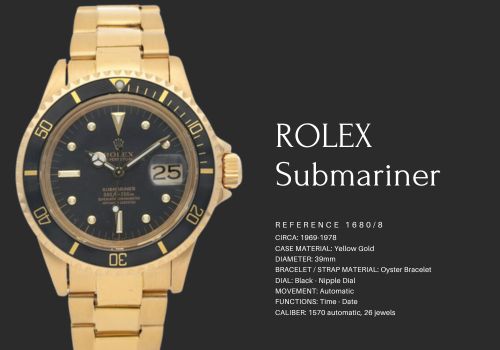
ROLEX SUBMARINER Models brief history

Rolex designed its very first first Submariner for the British Royal Navy. Presented in 1953, the Submariner was the first divers’ watch waterproof to a depth of 100 meters (330 feet) that gave them the ability with its rotatable bezel to read their immersion time. The Submariner has been ever since one of the most popular and cool sports watch not only among divers but for every watch addict who loves luxury sport watches.
ROLEX SUBMARINER
ROLEX SUBMARINER

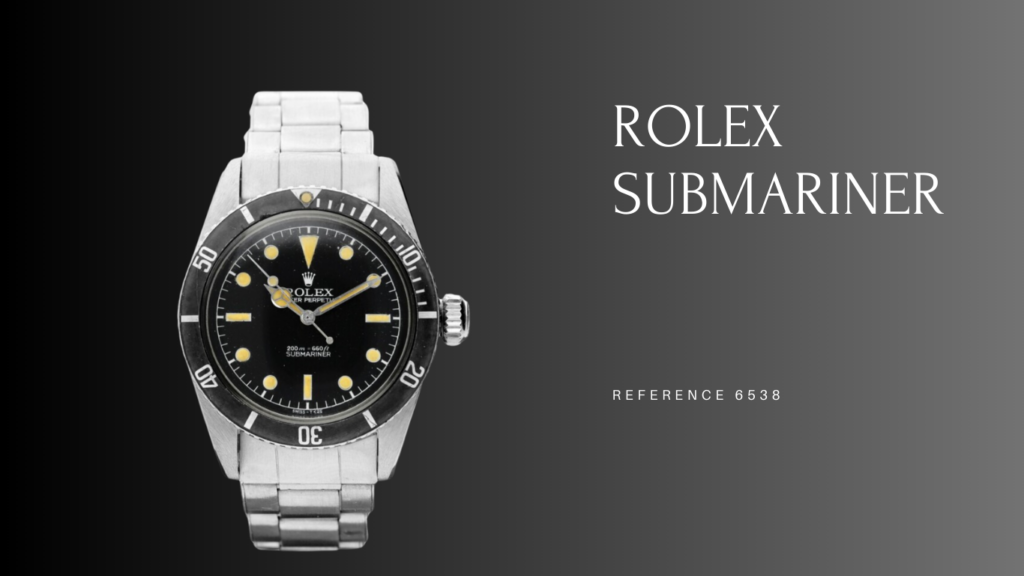
ROLEX SUBMARINER REF 6538

The first Submariner was introduced in 1957 along with the GMT Master II. The modern-day version of the Submariner was based on the GMT Master II. The GMT Master was  a supercase that was originally used in military watches and carried the same case. It’s new case was about a mm larger than the originals. The new in-house calibers used in the watches were 3230 and 3235 respectively. The new calibers provide improved accuracy and power reserve. The first version of the Submariner, the 6538, was even used by James Bond in various movies. The Mercedes hand is a popular addition in the film.

ROLEX SUBMARINER REF 6200

The second version of the Submariner was launched in 1964. This was the first model with a date window. The Ref. 6200 introduced a number of improvements to the Submariner, some of which were carried forward to later models. The dial was more popular, with a date window and a cushion-shaped Oyster case. The watch’s design was influenced by the Rolex Explorer. 

Materials…

Rolex Submariner has undergone incredible changes over the years, introducing 16 years later since it was presented the gold version (1969). It is interesting to mention that although Rolex prototyped the white gold version of 1680 it never released it for production. And the most important watch was 1680 that introduced to the Submariner series yellow  gold. 

ROLEX SUBMARINER Milestones over the years

6204  First Submariner A.260  (1953 – 1954)

6205  First Submariner A.260  (1954 – 1955)

6200  Mercedes Hands – A.296 (1954)

6538  First Submariner with Big Crown “James Bond” worn by Sean Connery in Dr. No  (1955 – 1959)

6538A Military Submariner  1030 “Coroncione” (1955 – 1959)

6536  Small Crown  1030 (1955 – 1959)

6536/1  Chronometer  1030 (1955 – 1959)

5508  Small Crown  1530 (1957 – 1961)

5510  Small Crown  1530 (1958)

5510 (1958 only – Big Crown)

5512  Chronometer- The Cornini  1530-1560-1570 (1959 – 1978)

5513  First Crown Guard  1520-1530 (1962 – 1989)

5514  Comex Submariner  1520 (1969 – 1977)

1680/8  First DATE in Yellow Gold  1575 (1969 – 1978)

1680  First Submariner Date  1575 (1969 – 1979)

5517  Military Submariner  1520 (1977)

16808 Submariner Date  Sapphire crystal Gold  3035 (1979 – 1987)

16800 Submariner Date  Transitional model  3035 (1979 – 1988)

16803 Submariner Date  Sapphire crystal SS/YG 3035 (1983 – 1988)

16610 Submariner Date  Superluminova Dial  3135 (1986** – Today)

16613 Submariner Date Superlum. Dial SS/YG  3135 (1986** – Today)

16618 Submariner Date  Superlum. Dial Gold  3135 (1986** – Today)

14060 First with Sapphire crystal  3000 (1988*- 2001)

14060M  Updated Automatic Movement  3130 (2001 – Today)

14060M  Submariner 

16610LV 50th Anniversary

114060 Submariner Ceramic bezel (2012-2019)

116610LN Submariner Date with Ceramic bezel (2012-2019)

124060 Submariner (2020 – present) equipped with caliber 3230

126610LN Submariner Date (2020 – present) equipped with 3235

Want to learn more? Read our next article regarding the full history of Submariner

Author

  • Julien Favre

    Vallée de Joux, Switzerland — Contributing Editor, high complications & independent watchmaking
    Julien Favre learned the difference between good silence and bad silence before he was ten. Good silence was his grandfather at the bench in Le Sentier, loupe screwed into one eye, breathing shallow over a disassembled minute repeater. Bad silence was the moment a hairspring pinged off the peg-wood and disappeared into the floorboards. The family atelier — three generations of movement servicing for the maisons that carpet the Vallée de Joux — was never framed as a legacy Julien was expected to join. It simply was the house, the way weather is the house in a mountain valley.
    He resisted it, predictably. He studied economics in Lausanne and spent two years in Geneva watch retail, selling the objects rather than opening them. What pulled him back was not sentiment but frustration: he found he could describe why a movement was beautiful far better than anyone selling it could, because he had seen its underside. He started writing — first a blog dissecting finishing under macro photography, then commissioned work for the trade press, then features that treated escapements the way music critics treat a fugue.
    Julien now covers high complications, restoration, and the fragile economics of independent watchmaking for European and English-language titles. His reporting is unusually technical without being cold; he is as interested in the person hunched over the bench as in the tolerances they hold. He is skeptical of hype, allergic to press-release adjectives, and reliably the first to notice when a "revolutionary" caliber is a reworked ébauche.
    He still returns to the family workshop each winter to service a single pocket watch on his grandfather's bench — a discipline, he says, that keeps his writing honest. A critic who cannot do the thing risks worshipping it.
    Byline version: Julien Favre is a contributing editor covering high complications and independent watchmaking. He grew up in a movement-servicing atelier in the Vallée de Joux and still works the family bench each winter

    Author
Author

Vallée de Joux, Switzerland — Contributing Editor, high complications & independent watchmaking Julien Favre learned the difference between good silence and bad silence before he was ten. Good silence was his grandfather at the bench in Le Sentier, loupe screwed into one eye, breathing shallow over a disassembled minute repeater. Bad silence was the moment a hairspring pinged off the peg-wood and disappeared into the floorboards. The family atelier — three generations of movement servicing for the maisons that carpet the Vallée de Joux — was never framed as a legacy Julien was expected to join. It simply was the house, the way weather is the house in a mountain valley. He resisted it, predictably. He studied economics in Lausanne and spent two years in Geneva watch retail, selling the objects rather than opening them. What pulled him back was not sentiment but frustration: he found he could describe why a movement was beautiful far better than anyone selling it could, because he had seen its underside. He started writing — first a blog dissecting finishing under macro photography, then commissioned work for the trade press, then features that treated escapements the way music critics treat a fugue. Julien now covers high complications, restoration, and the fragile economics of independent watchmaking for European and English-language titles. His reporting is unusually technical without being cold; he is as interested in the person hunched over the bench as in the tolerances they hold. He is skeptical of hype, allergic to press-release adjectives, and reliably the first to notice when a "revolutionary" caliber is a reworked ébauche. He still returns to the family workshop each winter to service a single pocket watch on his grandfather's bench — a discipline, he says, that keeps his writing honest. A critic who cannot do the thing risks worshipping it. Byline version: Julien Favre is a contributing editor covering high complications and independent watchmaking. He grew up in a movement-servicing atelier in the Vallée de Joux and still works the family bench each winter

Comments are closed.