Rolex has a very specific coding in all parts that helps you recognise the authenticity of the watch and parts especially when you are buying a preloved watch. The market of preloved watches is booming and actually in just numbers is bigger and generates billions in a yearly bases it is considered massively bigger that the first hand market.
The reasons that this is happening are many. Firstly it is price oriented, in many cases you can buy your favorite watch without having to buy it full price and in many cases depending the condition of the watch you can shave up to 40%. The second reason is that watches are like money, the change hands a lot as their value goes up over the years and in many cases they can be considered a great investment. And last but not least you can find collective watches only to the preloved market that will add important value to your collection. In the articles published you can recognise the collectable watches and understand what makes them so unique.
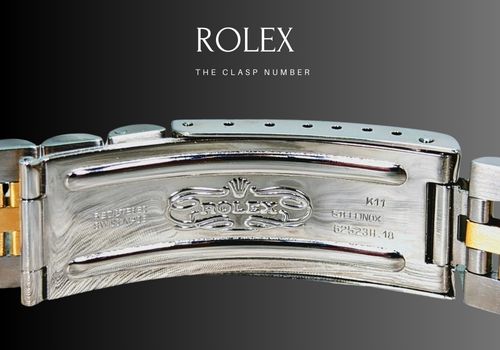
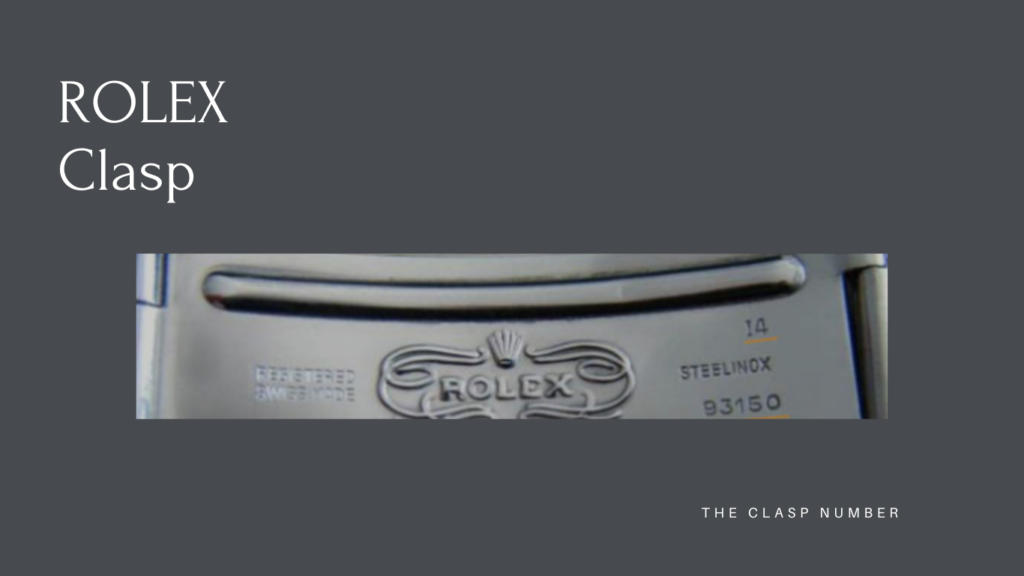
Rolex Bracelet Clasp Code
Quick Look on The Rolex Bracelet Clasp Code and Year
In the table above you can spot the year of production and the Rolex Bracelet Clasp Code, this is really important especially if you choose to purchase a preloved watch as you need to check that all the parts of the watch are original and matches the production year as well as the model type.
For example in many cases you can find that the year of the bracelet doesnt match the year of the model of the watch in this case you should get in contact with your watch dealer and inform him regarding the miss match and ask either for a refund or for a replacement as this decreases the value of your watch. Don’t miss the amazing article regarding Rolex Bezel Code Numbers
TABLE FOR ROLEX BRACELET CLASP CODES
Want to learn the year of production for your Rolex Clasp? Find below the year according to the letter engraved on your clasp.
Vallée de Joux, Switzerland — Contributing Editor, high complications & independent watchmaking
Julien Favre learned the difference between good silence and bad silence before he was ten. Good silence was his grandfather at the bench in Le Sentier, loupe screwed into one eye, breathing shallow over a disassembled minute repeater. Bad silence was the moment a hairspring pinged off the peg-wood and disappeared into the floorboards. The family atelier — three generations of movement servicing for the maisons that carpet the Vallée de Joux — was never framed as a legacy Julien was expected to join. It simply was the house, the way weather is the house in a mountain valley.
He resisted it, predictably. He studied economics in Lausanne and spent two years in Geneva watch retail, selling the objects rather than opening them. What pulled him back was not sentiment but frustration: he found he could describe why a movement was beautiful far better than anyone selling it could, because he had seen its underside. He started writing — first a blog dissecting finishing under macro photography, then commissioned work for the trade press, then features that treated escapements the way music critics treat a fugue.
Julien now covers high complications, restoration, and the fragile economics of independent watchmaking for European and English-language titles. His reporting is unusually technical without being cold; he is as interested in the person hunched over the bench as in the tolerances they hold. He is skeptical of hype, allergic to press-release adjectives, and reliably the first to notice when a "revolutionary" caliber is a reworked ébauche.
He still returns to the family workshop each winter to service a single pocket watch on his grandfather's bench — a discipline, he says, that keeps his writing honest. A critic who cannot do the thing risks worshipping it. Byline version: Julien Favre is a contributing editor covering high complications and independent watchmaking. He grew up in a movement-servicing atelier in the Vallée de Joux and still works the family bench each winter
Florence, Italy — Contributing Editor, design & aesthetics
Chiara Nardi grew up above a workshop that smelled of pickling acid and polishing rouge. The Nardi family have been goldsmiths in Florence for four generations, close enough to the Ponte Vecchio to hear the tourists; Chiara set stones and drew her first cases before she was allowed to use the rolling mill unsupervised. Watches entered her life as a subset of jewelry — objects judged first by proportion, weight in the hand, and the relationship between a dial and the wrist it lived on.
She trained formally in design in Milan and briefly designed cases for a component supplier, which taught her how compromised the beautiful object usually is by the time it reaches a boutique. She turned to writing because she wanted to argue about aesthetics in public rather than lose those arguments privately in a meeting.
Chiara covers watch design and the applied arts of the dial — enameling, guilloché, stone-setting, the near-lost decorative crafts the industry alternately celebrates and underpays. She writes with a maker's eye and a maker's impatience: she can tell when a "hand-finished" bevel was finished by a machine, and she names it. She is also one of the sharper voices on the industry's awkward relationship with women — as customers, as designers, and as the vast unnamed workforce that does the delicate assembly while men front the campaigns.
Her prose is sensory and precise. She writes about the tactility of objects the way food critics write about texture, and she refuses the lazy shorthand of "feminine" and "masculine" watches, which she considers marketing rather than design.
She still returns to the family bench to set stones by hand — proof, she says, that her opinions are earned. Byline version: Chiara Nardi is a contributing editor covering watch design and dial craft. A fourth-generation Florentine goldsmith, she writes about aesthetics with a maker's eye.
Vallée de Joux, Switzerland — Contributing Editor, high complications & independent watchmaking
Julien Favre learned the difference between good silence and bad silence before he was ten. Good silence was his grandfather at the bench in Le Sentier, loupe screwed into one eye, breathing shallow over a disassembled minute repeater. Bad silence was the moment a hairspring pinged off the peg-wood and disappeared into the floorboards. The family atelier — three generations of movement servicing for the maisons that carpet the Vallée de Joux — was never framed as a legacy Julien was expected to join. It simply was the house, the way weather is the house in a mountain valley.
He resisted it, predictably. He studied economics in Lausanne and spent two years in Geneva watch retail, selling the objects rather than opening them. What pulled him back was not sentiment but frustration: he found he could describe why a movement was beautiful far better than anyone selling it could, because he had seen its underside. He started writing — first a blog dissecting finishing under macro photography, then commissioned work for the trade press, then features that treated escapements the way music critics treat a fugue.
Julien now covers high complications, restoration, and the fragile economics of independent watchmaking for European and English-language titles. His reporting is unusually technical without being cold; he is as interested in the person hunched over the bench as in the tolerances they hold. He is skeptical of hype, allergic to press-release adjectives, and reliably the first to notice when a "revolutionary" caliber is a reworked ébauche.
He still returns to the family workshop each winter to service a single pocket watch on his grandfather's bench — a discipline, he says, that keeps his writing honest. A critic who cannot do the thing risks worshipping it.
Byline version: Julien Favre is a contributing editor covering high complications and independent watchmaking. He grew up in a movement-servicing atelier in the Vallée de Joux and still works the family bench each winter




Comments are closed.