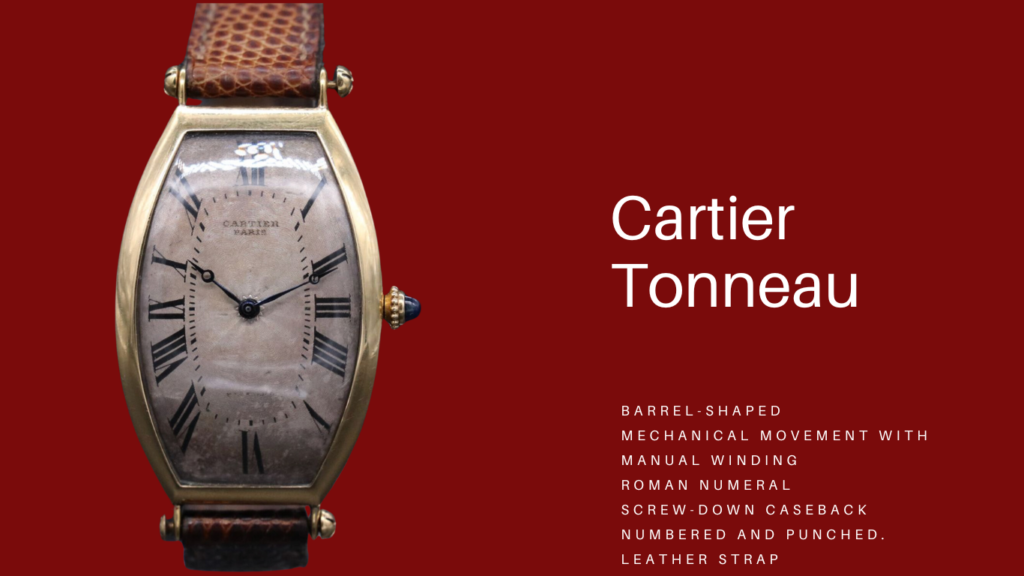
The famous Louis Cartier first introduced in 1906 the Tonneau-barrel shaped cases, where Tonneau in the french word for barrel. Just two years after the introduction of the famous Santos, the first men watch with a square shape.
THE TONNEAU Milestones
In 1906 Cartier is interrupting the tradition of pocket watches quite famous till now with the introduction of Tonneau.
in 1907 Cartier is women’s version that keeps the shape of the Tonneau case and add a sparkle with the amazing bracelets made from natural pearls, platinum and gold.
CARTIER TONNEAU
In 1911 Cartier is changing the way the lugs are connecting with the case and introduce the famous tube screws.
In 1924 in New York, Cartier is adopting a more girly approach that is reflected to its unique model that combines in the most absolute way the pearl bracelet with the pave diamonds on the case.
Moving one decades later the Tonneau collection comes back in 2004 with a model that personally brings me back a lot of memories of 1911. This specific model comes with a diamond bezel and a toile poudree strap.
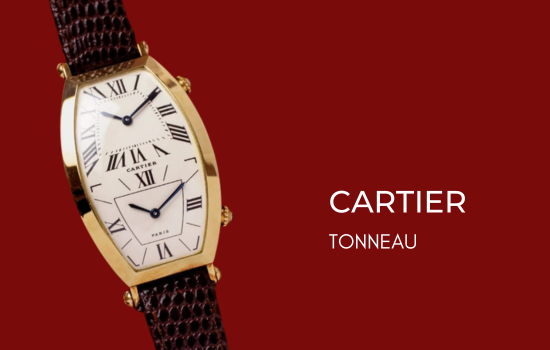
In 2005 Cartier is introducing a unique men’s watch that is featuring a dual time zone.
Cartier Tonneau Dual Time
In 2019 Cartier is coming back with two amazing models an updated design of the previous models and a skeleton dual time zone a certainly upgraded and beautiful version of the 2005 model.
Want to learn more about Cartier History? Check out our article that describes how everything started.
Feel free to contact and share your thoughts with us your feedback is important as we are trying to create a unique interactive community for all the watch fanatics.
Vallée de Joux, Switzerland — Contributing Editor, high complications & independent watchmaking
Julien Favre learned the difference between good silence and bad silence before he was ten. Good silence was his grandfather at the bench in Le Sentier, loupe screwed into one eye, breathing shallow over a disassembled minute repeater. Bad silence was the moment a hairspring pinged off the peg-wood and disappeared into the floorboards. The family atelier — three generations of movement servicing for the maisons that carpet the Vallée de Joux — was never framed as a legacy Julien was expected to join. It simply was the house, the way weather is the house in a mountain valley.
He resisted it, predictably. He studied economics in Lausanne and spent two years in Geneva watch retail, selling the objects rather than opening them. What pulled him back was not sentiment but frustration: he found he could describe why a movement was beautiful far better than anyone selling it could, because he had seen its underside. He started writing — first a blog dissecting finishing under macro photography, then commissioned work for the trade press, then features that treated escapements the way music critics treat a fugue.
Julien now covers high complications, restoration, and the fragile economics of independent watchmaking for European and English-language titles. His reporting is unusually technical without being cold; he is as interested in the person hunched over the bench as in the tolerances they hold. He is skeptical of hype, allergic to press-release adjectives, and reliably the first to notice when a "revolutionary" caliber is a reworked ébauche.
He still returns to the family workshop each winter to service a single pocket watch on his grandfather's bench — a discipline, he says, that keeps his writing honest. A critic who cannot do the thing risks worshipping it. Byline version: Julien Favre is a contributing editor covering high complications and independent watchmaking. He grew up in a movement-servicing atelier in the Vallée de Joux and still works the family bench each winter
Vallée de Joux, Switzerland — Contributing Editor, high complications & independent watchmaking
Julien Favre learned the difference between good silence and bad silence before he was ten. Good silence was his grandfather at the bench in Le Sentier, loupe screwed into one eye, breathing shallow over a disassembled minute repeater. Bad silence was the moment a hairspring pinged off the peg-wood and disappeared into the floorboards. The family atelier — three generations of movement servicing for the maisons that carpet the Vallée de Joux — was never framed as a legacy Julien was expected to join. It simply was the house, the way weather is the house in a mountain valley.
He resisted it, predictably. He studied economics in Lausanne and spent two years in Geneva watch retail, selling the objects rather than opening them. What pulled him back was not sentiment but frustration: he found he could describe why a movement was beautiful far better than anyone selling it could, because he had seen its underside. He started writing — first a blog dissecting finishing under macro photography, then commissioned work for the trade press, then features that treated escapements the way music critics treat a fugue.
Julien now covers high complications, restoration, and the fragile economics of independent watchmaking for European and English-language titles. His reporting is unusually technical without being cold; he is as interested in the person hunched over the bench as in the tolerances they hold. He is skeptical of hype, allergic to press-release adjectives, and reliably the first to notice when a "revolutionary" caliber is a reworked ébauche.
He still returns to the family workshop each winter to service a single pocket watch on his grandfather's bench — a discipline, he says, that keeps his writing honest. A critic who cannot do the thing risks worshipping it.
Byline version: Julien Favre is a contributing editor covering high complications and independent watchmaking. He grew up in a movement-servicing atelier in the Vallée de Joux and still works the family bench each winter








Comments are closed.