

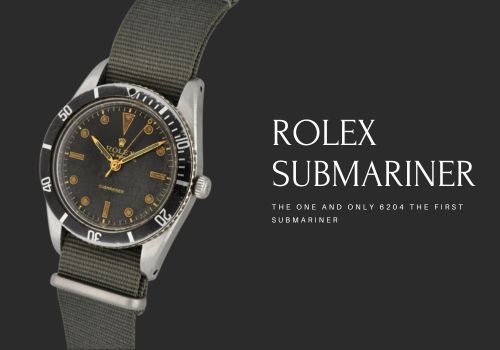
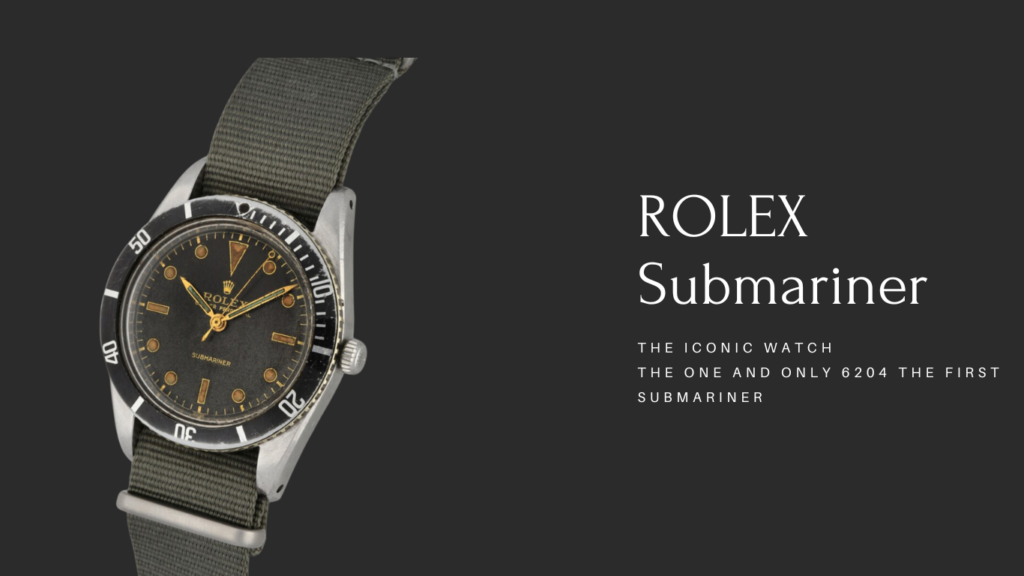
Rolex Submariner the Beginning
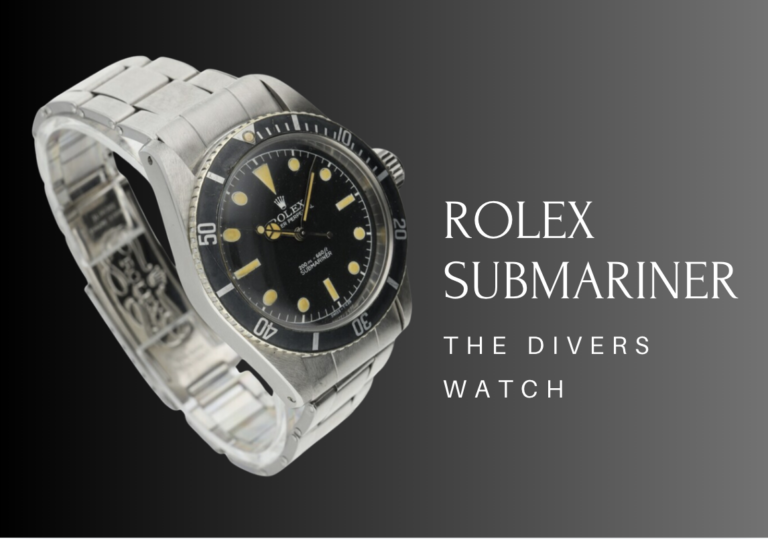
In the beginning of 1950s scuba diving became a rising sport among young Americans therefore the need of a watch that would be waterproof and precise in order for the divers to have an accurate way of the time they spend underwater was created. In 1953 Rolex created the Rolex Submariner, a watch exclusively designed for the specific needs of scuba diving waterproof to a depth of 100m that has been evolve over the years up to 300 metres. Its unique characteristics such as its rotatable bezel and large hands has made it a unique watch among scuba divers.
Rolex Submariner 6204 & 6205
Introduced officially a year later in 1954 the Submariner 6204, with an A260 movement and certified as waterproof up to 200 meters. The Submariner 6205, with a A260 movement and the Submariner 6200 fitted with A296 movement and a larger crown marked Brevet (patented) waterproof also up to 200 meters. In the following years quite a few collectors have questioned the chronological order of the first three models of Submariner but as a logic consequence we can safely say that as Submariner 6204 and 6205 share the same movement they were produced together and Submariner 6200 follows with a different and better movement A296.

Auguste Piccard the incredible mind behind Rolex Submariner evolution
Are you up for it? It is always fascinating when two minds that don’t think alike join their forces and their creative minds. This happened when August Piccard and Rolex connected, but lets dive a little bit to the life of this incredible mind. August Piccard was a Swiss physicist and explorer that came into publicity due to his record breaking hydrogen balloon flights that allowed him to study Earths upper atmosphere and became the first person to enter the Stratosphere. Piccard after this incredible journey on space, in 1948 he invented the first bathyscaphe that allowed the divers to explore the ocean in depths that they have never imagined before.
In 1953 two very different Submariners were produced for the Swiss scientist Professor Auguste Piccard for his dives in Trieste named Deep Sea Specials and Piccard. On the 30th September 1953 with Deep Sea Specials, Rolex made a world record dive to 3155 with Auguste Piccard team. Seven years later in 1960 under Jaques Piccard’s son August Piccard 7205/0 conquered a new world record to 11000 meters.
1954 what an interesting year for Rolex Submariner!
1954 was a fascinating year for Submariner and Rolex fanatics as it is the year that Rolex is experimenting with the name of Submariner and launching Frogman, Skin Diver, Dive-O-Graph and Deep Sea Diver and does not conclude until the ten years later in the 1960s.
Rolex Submariner 1030 Movement
In 1955 Submariner re-released 6204 and 6205 with the new 1030 movement. 6204 was renamed as 6538 and 6536 replaced 6205 adding to them a larger crown. Rolex re offered 6536 with a chronometer version named 6536/1.
Rolex Submariner Reference Guide
This is your quick reference guide that includes the reference and the years of production, if you require more information regarding all the Submariners models please check our article “THE 32 AMAZING ROLEX SUBMARINER MODELS”
Rolex Submariner References (1953-Present)
6204 First Submariner A.260 (1953 – 1954)
6205 First Submariner A.260 (1954 – 1955)
6200 Mercedes Hands – A.296 (1954)
6538 First Submariner with Big Crown “James Bond” worn by Sean Connery in Dr. No (1955 – 1959)
6538A Military Submariner 1030 “Coroncione” (1955 – 1959)
6536 Small Crown 1030 (1955 – 1959)
6536/1 Chronometer 1030 (1955 – 1959)
5508 Small Crown 1530 (1957 – 1961)
5510 Small Crown 1530 (1958)
5510 (1958 only – Big Crown)
5512 Chronometer- The Cornini 1530-1560-1570 (1959 – 1978)
5513 First Crown Guard 1520-1530 (1962 – 1989)
5514 Comex Submariner 1520 (1969 – 1977)
1680/8 First DATE in Yellow Gold 1575 (1969 – 1978)
1680 First Submariner Date 1575 (1969 – 1979)
5517 Military Submariner 1520 (1977)
16808 Submariner Date Sapphire crystal Gold 3035 (1979 – 1987)
16800 Submariner Date Transitional model 3035 (1979 – 1988)
16803 Submariner Date Sapphire crystal SS/YG 3035 (1983 – 1988)
16610 Submariner Date Superluminova Dial 3135 (1986** – Today)
16613 Submariner Date Superlum. Dial SS/YG 3135 (1986** – Today)
16618 Submariner Date Superlum. Dial Gold 3135 (1986** – Today)
14060 First with Sapphire crystal 3000 (1988*- 2001)
14060M Updated Automatic Movement 3130 (2001 – Today)
14060M Submariner
16610LV 50th Anniversary
114060 Submariner Ceramic bezel (2012-2019)
116610LN Submariner Date with Ceramic bezel (2012-2019)
124060 Submariner (2020 – present) equipped with caliber 3230
126610LN Submariner Date (2020 – present) equipped with 3235
Want to learn more about Rolex History? Check out our article that describes how everything started.
Feel free to contact and share your thoughts with us your feedback is important as we are trying to create a unique interactive community for all the watch fanatics.



Comments are closed.