I am personally in love with Rolex Milgauss History and this amazing watch that was discontinued in 2023 had his glory days in that year as everyone start looking more carefully this amazing and unique watch with his unique design and quite poetic hands. Maybe with Milgauss in this article you can find me exaggerating but honestly I can hide my love for this absolutely amazing watch were everything is unique.
ROLEX MILGAUSS
ROLEX MILGAUSS Reference 6451
Rolex Milgauss was introduced in 1956 under the reference 6451, designed to serve the specific needs of the science and had the need of an antimagnetic watch. The scientist till then has a specific problem to face the time was disrupt due to the electromagnetic field that was greater than 50 to 100 gauss. That had as a result the scientists either not to wear a watch or to have a watch that was not working properly.
The need of a watch that would overcome this difficulties was vital, and Rolex as always accepted this challenge and Milgauss was created that took its name after Mil that comes from the French world 1000 and Gauss- that is used in order to measure the magnetic field.
In the 1950s Rolex Milgauss was tested by the European Organization for Nuclear Research (CERN), the European Organization for Nuclear Research, is one of the world’s largest and most respected centres for scientific research that started operating in 1952. CERN results were important not only for both scientific and watch community as they were able to identify that Milgauss resisted magnetic fields up to 1000 gauss.
Nevertheless the watch was not particular popular to the rest of the world and was discontinued in 1988. In 2007 Rolex decided to give one more chance to this iconic and special watch under the reference 116400 that was discontinued again in 2023.
ROLEX MILGAUSS Reference Numbers
1019: One of the most sought-after vintage Milgauss. Without luminous dots as requested by CERN who needed watch which wouldn’t interfere with their experiments since the tritium used as the luminous material emitted radioactive ”signals”. Because of this non-lune version, the 1019 Milgauss has become one of the more desirable vintage Milgauss models.
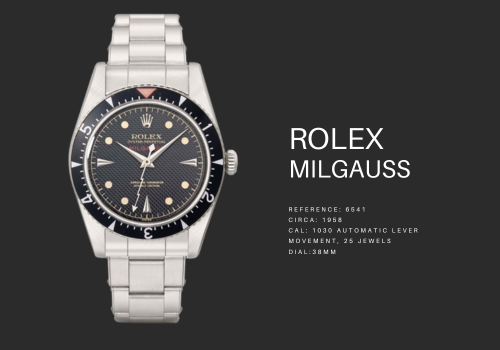
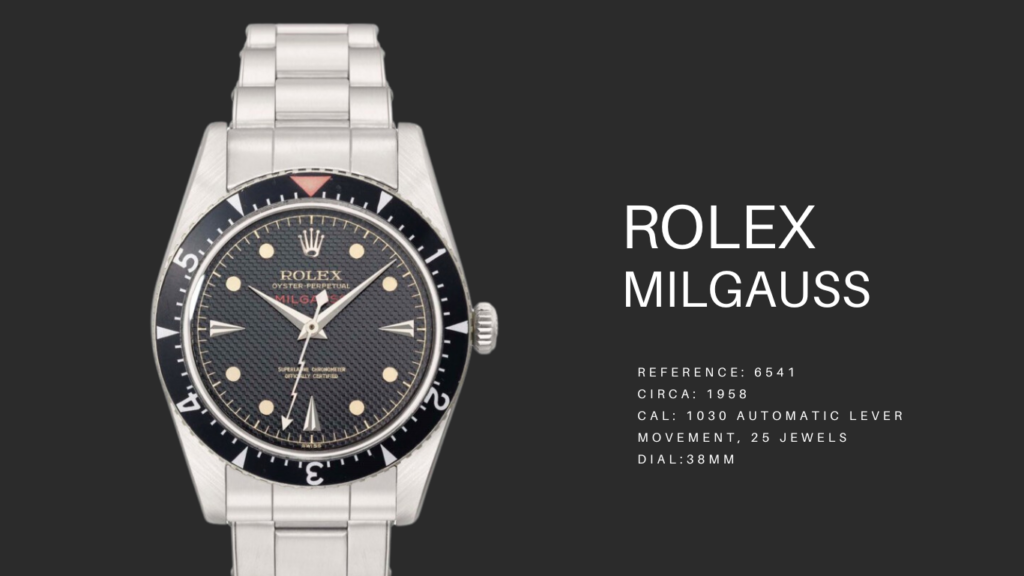
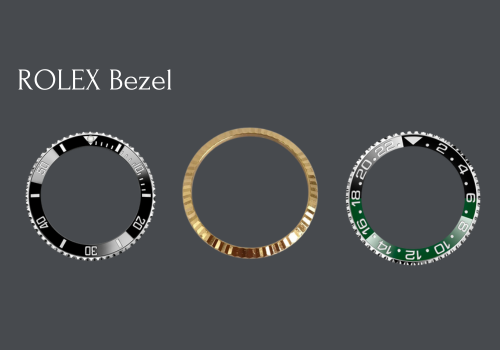
6541: Similar to an early Submariner in its case design. 25-jewel, self-winding movement. Featuring a black rotating bezel. lightning bolt-shaped seconds hand.
116400GV: The anniversary Milgauss edition “glass verte” with green sapphire glass.
116400: The first model in Rolex’s revived Milgauss collection which launched in 2007 after nearly two decades of absence.
Want to learn more about how everything started? Check out this interesting article regarding ROLEX HISTORY
Vallée de Joux, Switzerland — Contributing Editor, high complications & independent watchmaking
Julien Favre learned the difference between good silence and bad silence before he was ten. Good silence was his grandfather at the bench in Le Sentier, loupe screwed into one eye, breathing shallow over a disassembled minute repeater. Bad silence was the moment a hairspring pinged off the peg-wood and disappeared into the floorboards. The family atelier — three generations of movement servicing for the maisons that carpet the Vallée de Joux — was never framed as a legacy Julien was expected to join. It simply was the house, the way weather is the house in a mountain valley.
He resisted it, predictably. He studied economics in Lausanne and spent two years in Geneva watch retail, selling the objects rather than opening them. What pulled him back was not sentiment but frustration: he found he could describe why a movement was beautiful far better than anyone selling it could, because he had seen its underside. He started writing — first a blog dissecting finishing under macro photography, then commissioned work for the trade press, then features that treated escapements the way music critics treat a fugue.
Julien now covers high complications, restoration, and the fragile economics of independent watchmaking for European and English-language titles. His reporting is unusually technical without being cold; he is as interested in the person hunched over the bench as in the tolerances they hold. He is skeptical of hype, allergic to press-release adjectives, and reliably the first to notice when a "revolutionary" caliber is a reworked ébauche.
He still returns to the family workshop each winter to service a single pocket watch on his grandfather's bench — a discipline, he says, that keeps his writing honest. A critic who cannot do the thing risks worshipping it. Byline version: Julien Favre is a contributing editor covering high complications and independent watchmaking. He grew up in a movement-servicing atelier in the Vallée de Joux and still works the family bench each winter
Vallée de Joux, Switzerland — Contributing Editor, high complications & independent watchmaking
Julien Favre learned the difference between good silence and bad silence before he was ten. Good silence was his grandfather at the bench in Le Sentier, loupe screwed into one eye, breathing shallow over a disassembled minute repeater. Bad silence was the moment a hairspring pinged off the peg-wood and disappeared into the floorboards. The family atelier — three generations of movement servicing for the maisons that carpet the Vallée de Joux — was never framed as a legacy Julien was expected to join. It simply was the house, the way weather is the house in a mountain valley.
He resisted it, predictably. He studied economics in Lausanne and spent two years in Geneva watch retail, selling the objects rather than opening them. What pulled him back was not sentiment but frustration: he found he could describe why a movement was beautiful far better than anyone selling it could, because he had seen its underside. He started writing — first a blog dissecting finishing under macro photography, then commissioned work for the trade press, then features that treated escapements the way music critics treat a fugue.
Julien now covers high complications, restoration, and the fragile economics of independent watchmaking for European and English-language titles. His reporting is unusually technical without being cold; he is as interested in the person hunched over the bench as in the tolerances they hold. He is skeptical of hype, allergic to press-release adjectives, and reliably the first to notice when a "revolutionary" caliber is a reworked ébauche.
He still returns to the family workshop each winter to service a single pocket watch on his grandfather's bench — a discipline, he says, that keeps his writing honest. A critic who cannot do the thing risks worshipping it.
Byline version: Julien Favre is a contributing editor covering high complications and independent watchmaking. He grew up in a movement-servicing atelier in the Vallée de Joux and still works the family bench each winter








Comments are closed.