ROLEX AIR-KING History

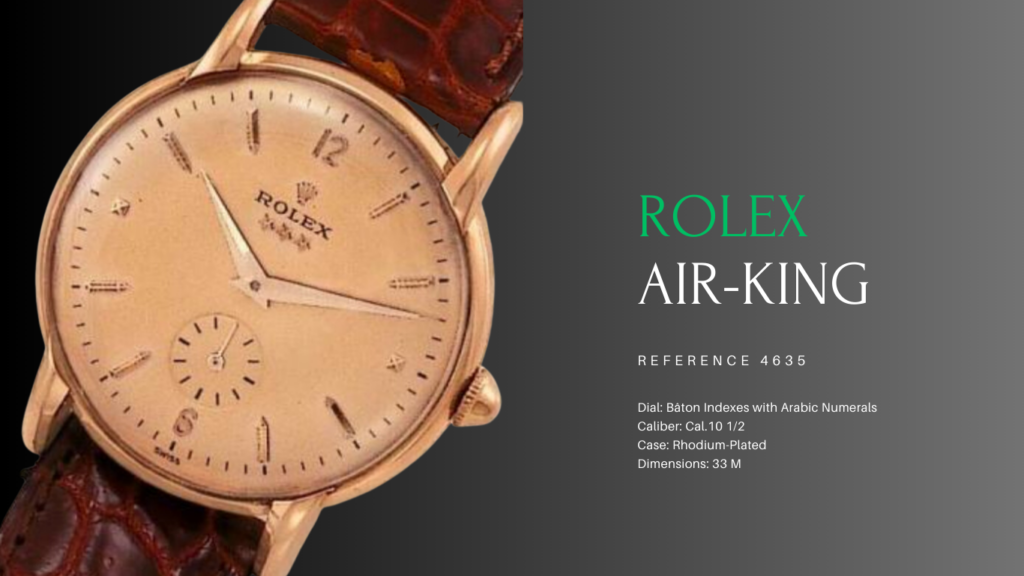
The Rolex Air-King was introduced in 1945, alongside the Datejust in order to celebrate the 40th anniversary of Rolex with 4635.  This new model paid tribute to the British Royal Air Force that loved Rolex watches , and as it was introduced during World War II  it was named Air King. In its early days it was not popular up until the introduction of 5500 in 1957 that can perceived actually as the starting point of Rolex Air King history.

ROLEX AIR-KING ref 4635

Made in the 1940s. The first Rolex Air-King, Circa: 1940s Ref: 4635, Dial: Bâton Indexes with Arabic Numerals , Caliber: Cal.10 1/2 , Case: Rhodium-Plated, Dimensions: 33 MM

ROLEX AIR-KING 4635

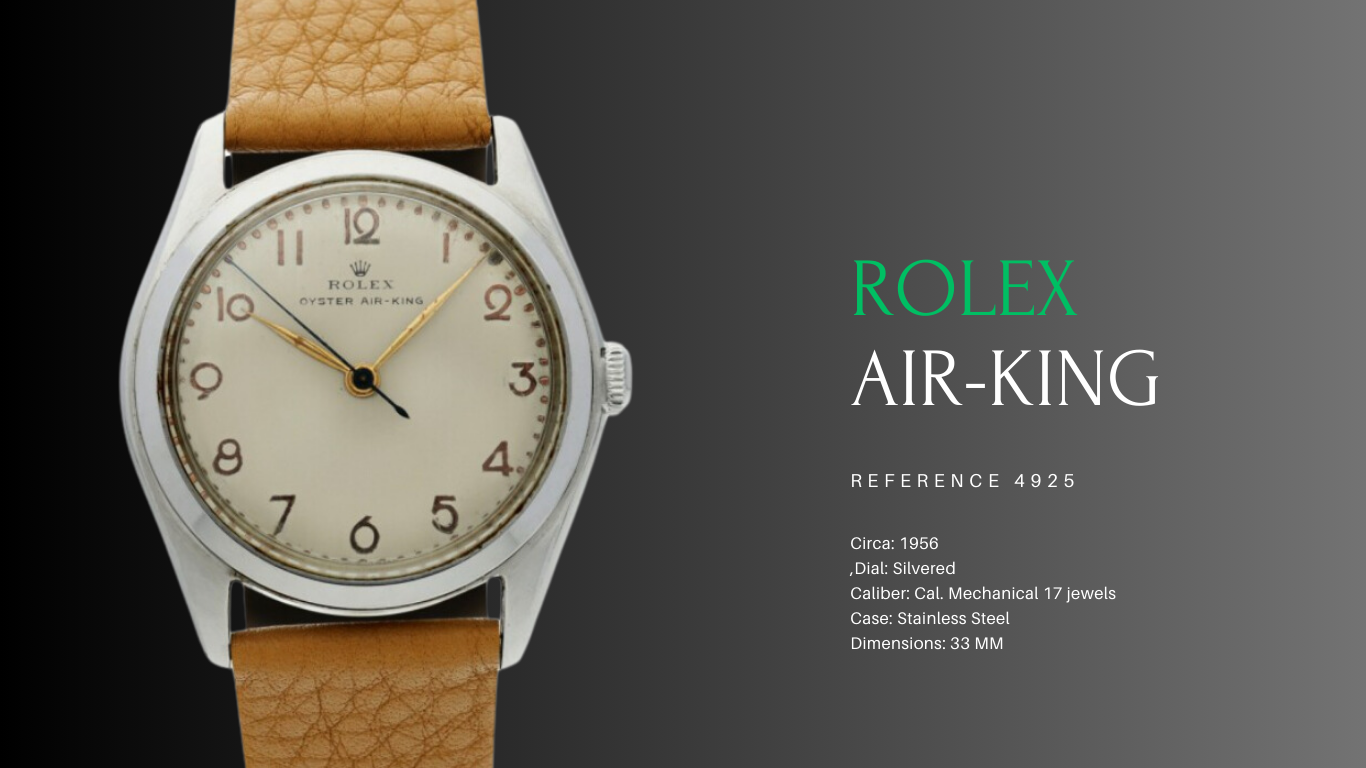
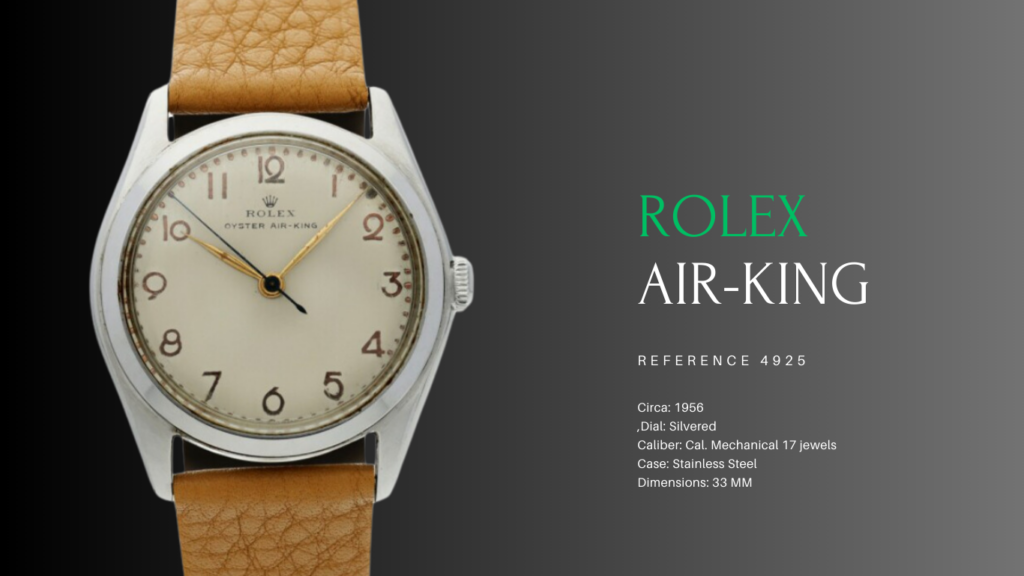
ROLEX AIR-KING ref 4925

Is the first Rolex Air King that feature the Air-King Moniker on the dial. Reference: 4925, Circa: 1956, Dimensions:  33MM
ROLEX AIR-KING 4925


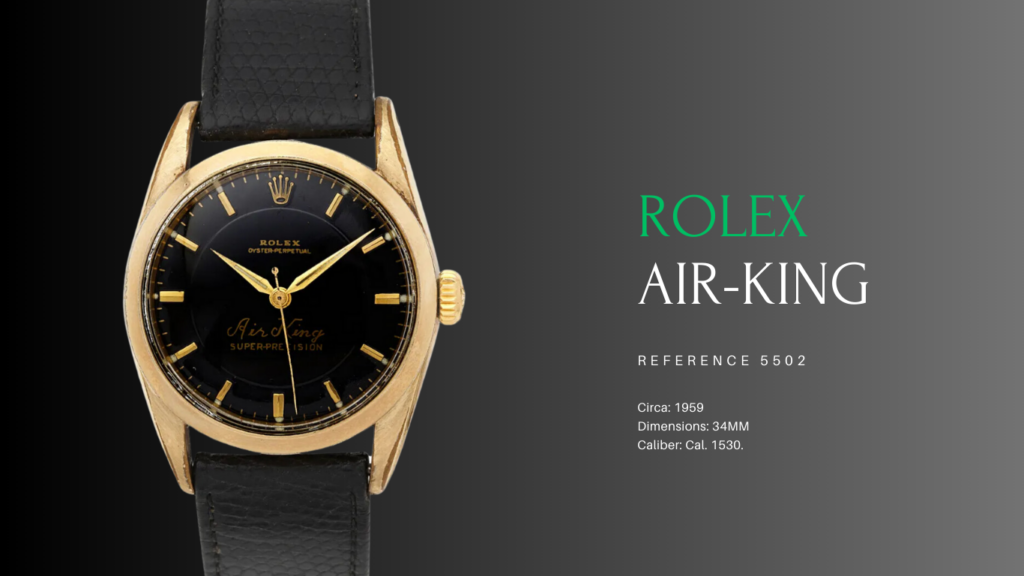
ROLEX AIR-KING ref 5502

Reference: 5502, Circa: 1959, Dimensions:  34MM Caliber: Cal. 1530 Automatic Movement, Acrylic Crystal
ROLEX AIR-KING 5502

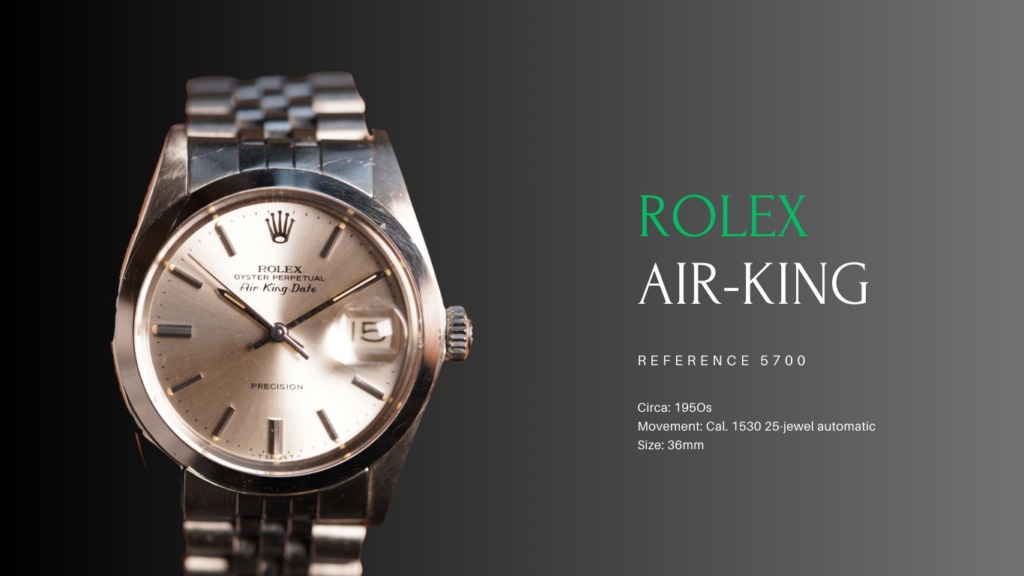
ROLEX AIR-KING ref 5700

Reference: 5700 Circa: c. 195Os Movement: Cal. 1530 25-jewel automatic, Size: 36mm Dial: Blue, linen, or silver dial.
ROLEX AIR-KING 5700


ROLEX AIR-KING ref 5501

Reference: 5501, Produced: 1958, Dimensions:  34MM Caliber:  1520
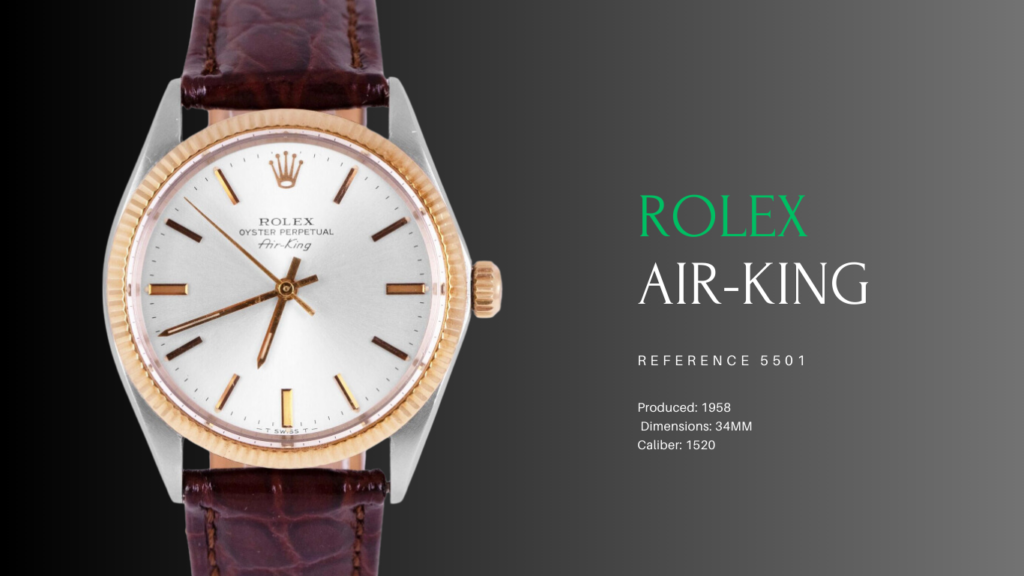
ROLEX AIR-KING 5501


ROLEX AIR-KING ref 5504

Reference: 5504, Produced: 1958, Dimensions:  36MM Caliber:  1530
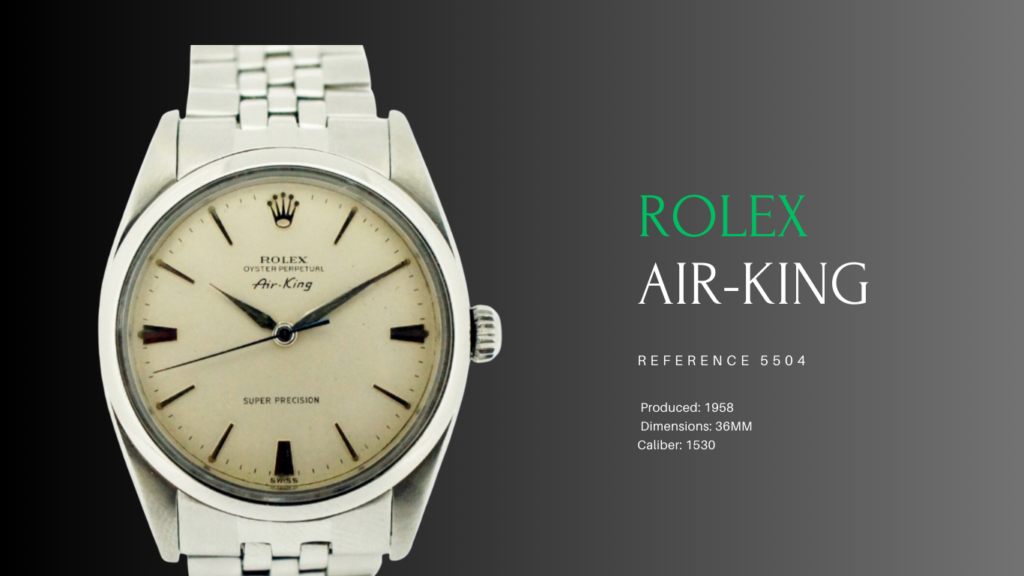
ROLEX AIR-KING 5504


ROLEX AIR-KING ref 5506

Reference: 5506, Produced: 1961 , Dimensions:  34MM Caliber:  1530 Automatic movement Case: Yellow gold plated, Acrylic Crystal
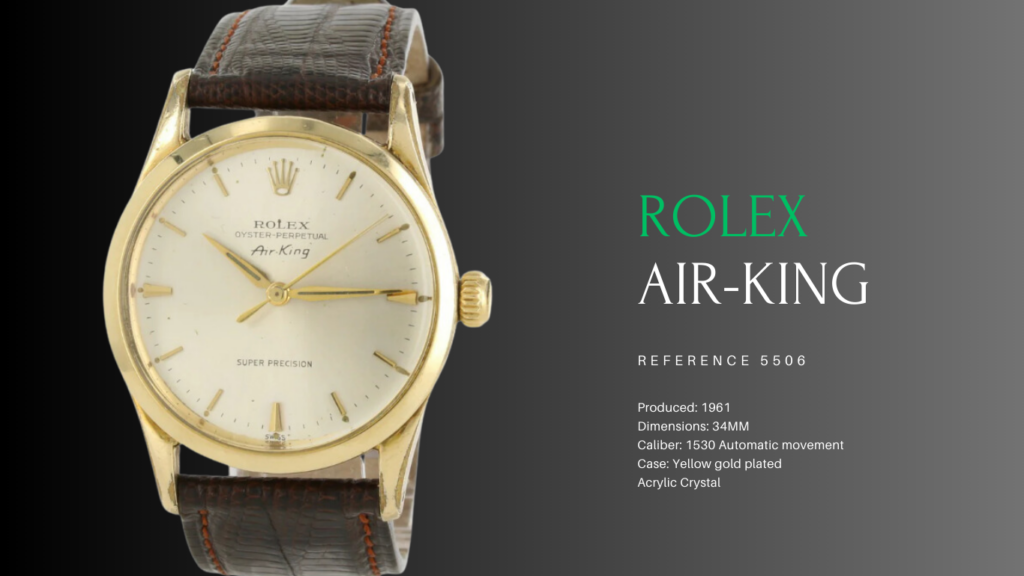
ROLEX AIR-KING 5506

ROLEX AIR-KING ref 5500

Reference: 5500, Circa:  1969 Material:Steel/ Gold, Dimensions:  34MM Caliber: Cal. 1530 Automatic Movement, Acrylic Crystal
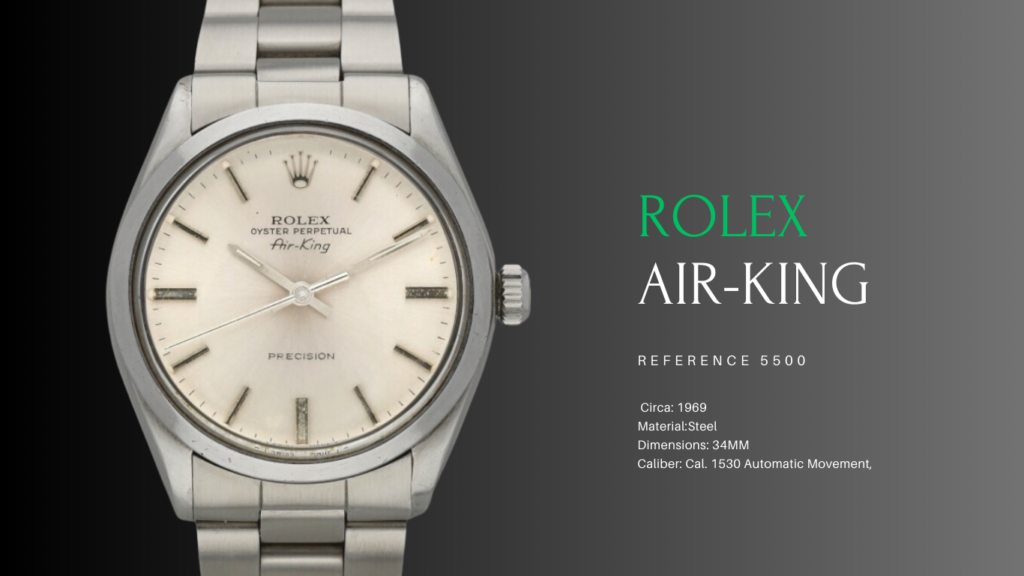
ROLEX AIR-KING 5500


ROLEX AIR-KING ref 5520

Reference: 5520, Circa:  1970 Material:Steel/ Gold, Dimensions:  34MM Caliber: Cal. 1520 Automatic Movement, Acrylic Crystal
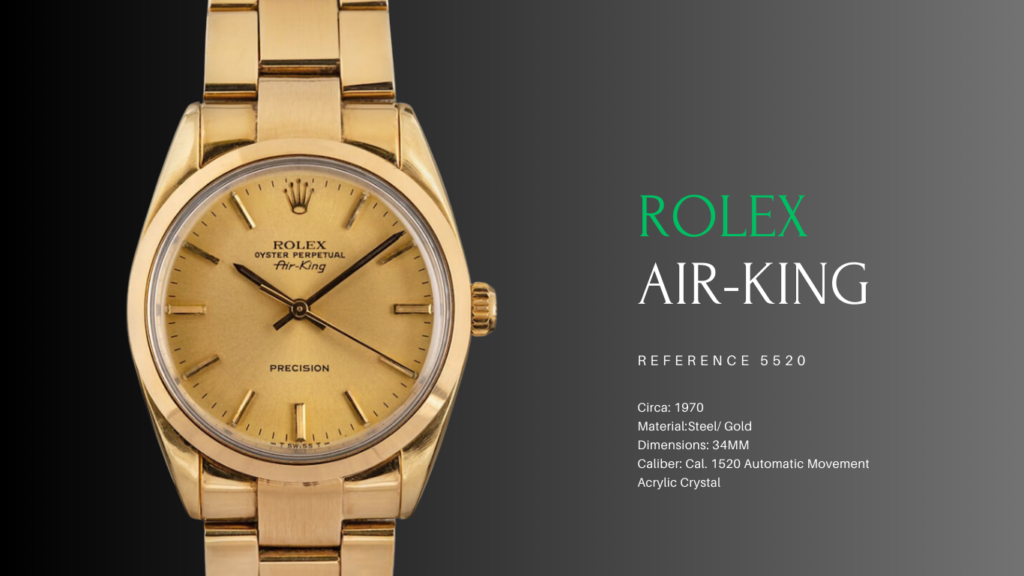
ROLEX AIR-KING 5520

ROLEX AIR-KING ref 6500

Reference: 6500, Circa:  1975 Material:Steel/ Gold, Dimensions:  34MM Caliber: Cal. 1520 Automatic Movement, Acrylic Crystal
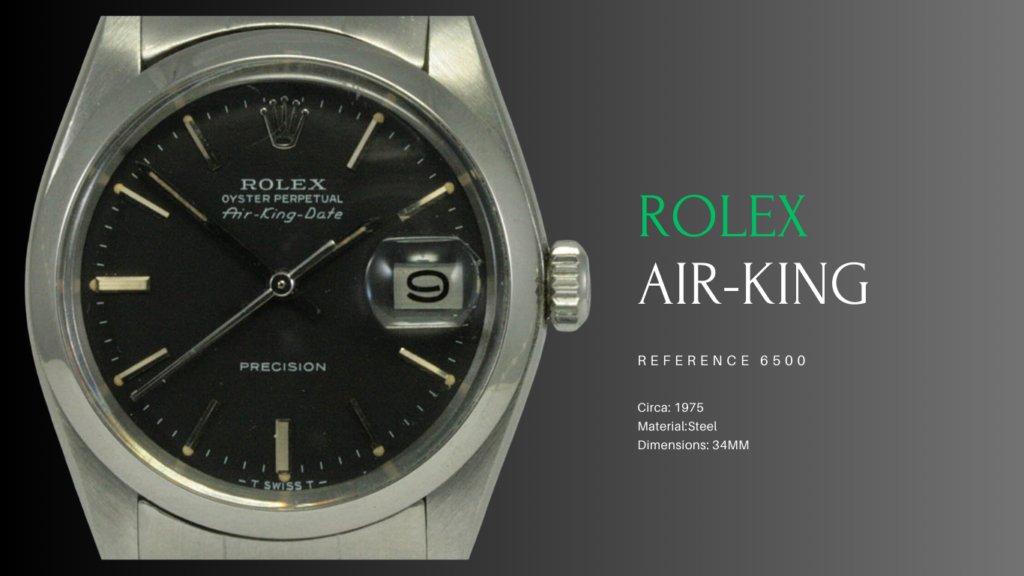
ROLEX AIR-KING 6500


ROLEX AIR-KING ref 14000

In 1989 Rolex introduced the 14000 that was discontinued 10 year laters in 1999. The original idea was to replace the 5500 with a new model that would offer a sapphire crystal, a smooth bezel and the 3000 movement to its fans.

Reference: 14000, Produced: 1989 – 1999, Dimensions:  34MM Caliber:  3000

ROLEX AIR-KING ref 14000M

Reference: 14000M, Produced: 2000, Dimensions:  34MM Caliber:  3130, Automatic movement, Scratch-resistant sapphire crystal

ROLEX AIR-KING ref 14010M

Reference: 14010M, Produced: 2006, Dimensions:  34MM Caliber:  3130 Automatic movement
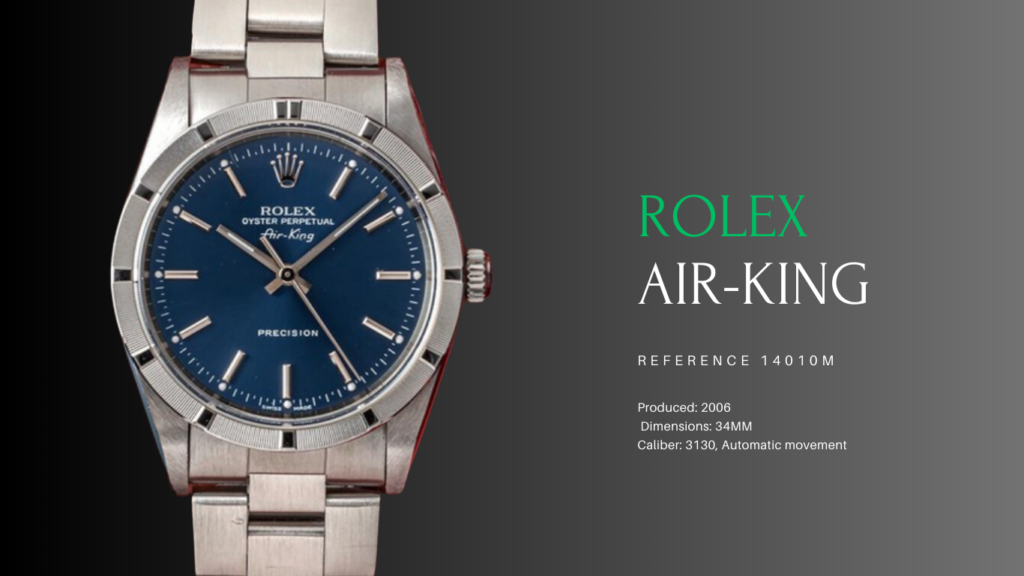
ROLEX AIR-KING 14010M

ROLEX AIR-KING ref 114234

Reference: 114234, Produced: 2006, Dimensions:  34MM Caliber:  3130 Automatic movement. Is considered the last model of the first generation of Air King 34MM it discontinued in 2014 after 7 years only. In 2016, Rolex re -introduced  Rolex Air- King with the 40mm Ref 116900.
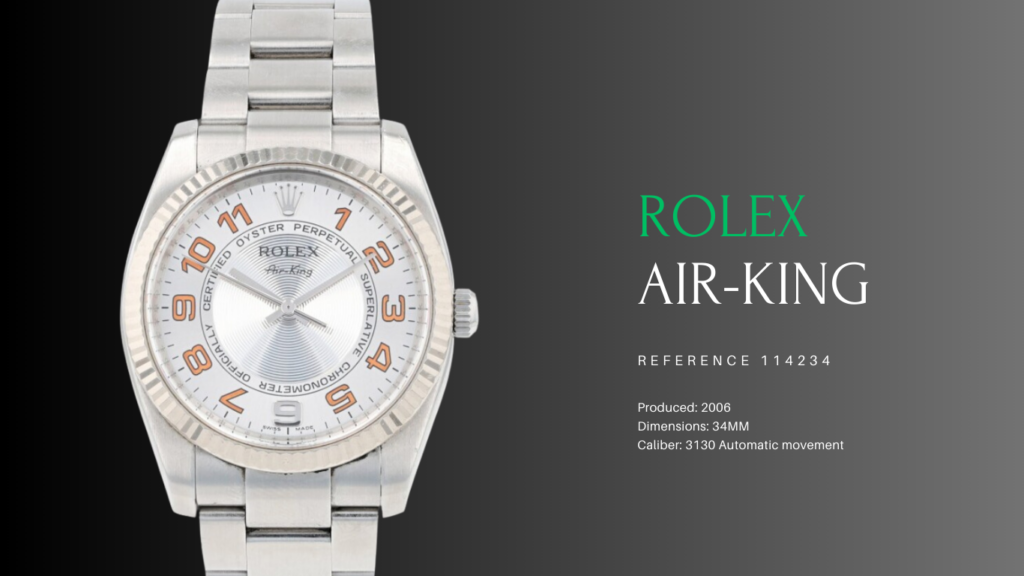
ROLEX AIR-KING 114234


ROLEX AIR-KING ref 114210

Reference: 114210, Produced: 2006-2010, Dimensions:  34MM Caliber:  3130 Automatic movement. 
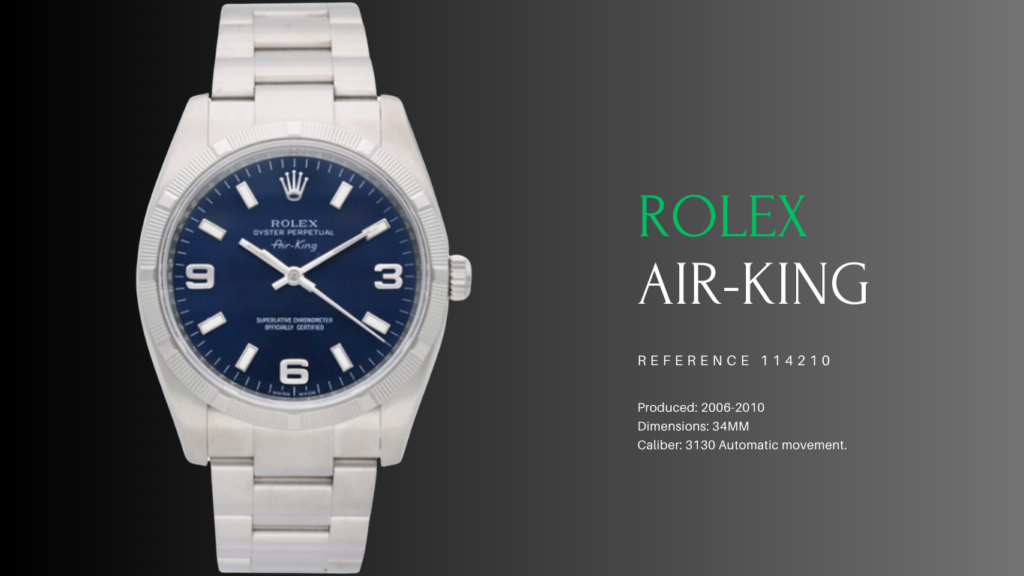
ROLEX AIR-KING 114210


ROLEX AIR-KING ref 114200

Reference: 114200, Produced: , Dimensions:  34MM Caliber:  3130 Automatic movement. 


ROLEX AIR-KING ref 6552

Reference: 6552, Produced: 1953, Dimensions:  34MM Caliber:  1030 Automatic movement. 


ROLEX AIR-KING ref 1002

The 1002 is often quoted as an Air-King model, but it never was – it was only an Oyster perpetual.


ROLEX AIR-KING ref 1401

Stainless Steel. Water Resistant to 100 meters. 

ROLEX AIR-KING ref 5701

A less-common model than most Air-King references.

ROLEX AIR-KING ref 116900

The newest and current Air-King model. Released in 2016. 39mm case.


Want to learn more about Rolex History? Check out our article that describes how everything started.

Feel free to contact and share your thoughts with us your feedback is important as we are trying to create a unique interactive community for all the watch fanatics.

Author

  • Florence, Italy — Contributing Editor, design & aesthetics
    Chiara Nardi grew up above a workshop that smelled of pickling acid and polishing rouge. The Nardi family have been goldsmiths in Florence for four generations, close enough to the Ponte Vecchio to hear the tourists; Chiara set stones and drew her first cases before she was allowed to use the rolling mill unsupervised. Watches entered her life as a subset of jewelry — objects judged first by proportion, weight in the hand, and the relationship between a dial and the wrist it lived on.
    She trained formally in design in Milan and briefly designed cases for a component supplier, which taught her how compromised the beautiful object usually is by the time it reaches a boutique. She turned to writing because she wanted to argue about aesthetics in public rather than lose those arguments privately in a meeting.
    Chiara covers watch design and the applied arts of the dial — enameling, guilloché, stone-setting, the near-lost decorative crafts the industry alternately celebrates and underpays. She writes with a maker's eye and a maker's impatience: she can tell when a "hand-finished" bevel was finished by a machine, and she names it. She is also one of the sharper voices on the industry's awkward relationship with women — as customers, as designers, and as the vast unnamed workforce that does the delicate assembly while men front the campaigns.
    Her prose is sensory and precise. She writes about the tactility of objects the way food critics write about texture, and she refuses the lazy shorthand of "feminine" and "masculine" watches, which she considers marketing rather than design.
    She still returns to the family bench to set stones by hand — proof, she says, that her opinions are earned.
    Byline version: Chiara Nardi is a contributing editor covering watch design and dial craft. A fourth-generation Florentine goldsmith, she writes about aesthetics with a maker's eye.

Author

Florence, Italy — Contributing Editor, design & aesthetics Chiara Nardi grew up above a workshop that smelled of pickling acid and polishing rouge. The Nardi family have been goldsmiths in Florence for four generations, close enough to the Ponte Vecchio to hear the tourists; Chiara set stones and drew her first cases before she was allowed to use the rolling mill unsupervised. Watches entered her life as a subset of jewelry — objects judged first by proportion, weight in the hand, and the relationship between a dial and the wrist it lived on. She trained formally in design in Milan and briefly designed cases for a component supplier, which taught her how compromised the beautiful object usually is by the time it reaches a boutique. She turned to writing because she wanted to argue about aesthetics in public rather than lose those arguments privately in a meeting. Chiara covers watch design and the applied arts of the dial — enameling, guilloché, stone-setting, the near-lost decorative crafts the industry alternately celebrates and underpays. She writes with a maker's eye and a maker's impatience: she can tell when a "hand-finished" bevel was finished by a machine, and she names it. She is also one of the sharper voices on the industry's awkward relationship with women — as customers, as designers, and as the vast unnamed workforce that does the delicate assembly while men front the campaigns. Her prose is sensory and precise. She writes about the tactility of objects the way food critics write about texture, and she refuses the lazy shorthand of "feminine" and "masculine" watches, which she considers marketing rather than design. She still returns to the family bench to set stones by hand — proof, she says, that her opinions are earned. Byline version: Chiara Nardi is a contributing editor covering watch design and dial craft. A fourth-generation Florentine goldsmith, she writes about aesthetics with a maker's eye.

Comments are closed.